E-Paper







Gowri S is a principal correspondent with HT’s Sunday longform features section, HT Wknd. With eight years of experience in feature journalism, she covers culture, the arts, environment, climate crisis, technology and history with a focus on India and the world. On an off day, find her nose-deep in a new playlist, or between deadlift sets.
Here, boy!: Wknd offers a ruff guide to dogs in art
Updated on: Nov 21, 2026, 20:30:12 IST


Share via
Copy link

Dogs know us intimately, yet look up to us; they expect the best of us. In art, they also signify emotion, point the viewer towards vital details. Take a look.
In Native American lore, the creator is thought to have had a canine best friend.
In South American myth, the dog was the first animal created, after man and woman, so it could keep them company.
The truth is perhaps even more evocative. In the Chauvet caves of France, 36,000 years ago, palaeolithic humans drew a spectacular world of animals: bears, mammoths, woolly rhinos.
The wolf / dog isn’t depicted, except as paw prints beside the footprints of a child.
All these aeons later, dogs are still appearing, over and over: In stone and on canvas, in folk art and sculpture, in Ancient Egypt and 2nd century Rome, 8th-century China, 17th-century Japan and 18th-century India, all the way through to the present day.
“Dogs play a part, more than any other animal, in the stories we tell about ourselves and our world,” says American historian Thomas Laqueur, professor emeritus of history at University of California, Berkeley, and author of The Dog’s Gaze: A Visual History (2026).
In his book, Laqueur traces such depictions back 9,000 years, to hunting petroglyphs carved into rock in the deserts of Saudi Arabia and to the Bhimbetka rock shelters of Madhya Pradesh, where 41 drawings of dogs as hunting partners have been documented.
He explores how the presence of a canine inadvertently reorganises how we respond to the artwork, establishing the emotional register of a painting or sculpture; pointing us to elements and telling us where to look; setting up connections between aspects of the image, as well as between the image and us, its observers.
The Victorian critic John Ruskin argued that artists of 16th-century Renaissance Venice such as Titian, Veronese and Tintoretto painted dogs “to give the fullest contrast to the highest tones of human thought and feeling”. They were the “connecting link between man and animals,” he said. This idea recurs in art too.
These are animals that know us intimately, yet look up to us; expect the best of us, and occasionally judge (in disappointment, if not censure). Equally, these are animals we place on a pedestal and anthropomorphise, projecting onto them our own emotions, or ideas of pride or honour.
“Dogs are often there because of the emotional work they do,” says Laqueur. They serve as shorthand for devotion, mourning, loyalty, love, loneliness, confusion. Consider the pathos of Edwin Landseer 1837 masterful work, The Old Shepherd’s Chief Mourner. These and others make our list. Take a tour.
.
* DOG WITH PUPS; c. 1780; Rajasthan
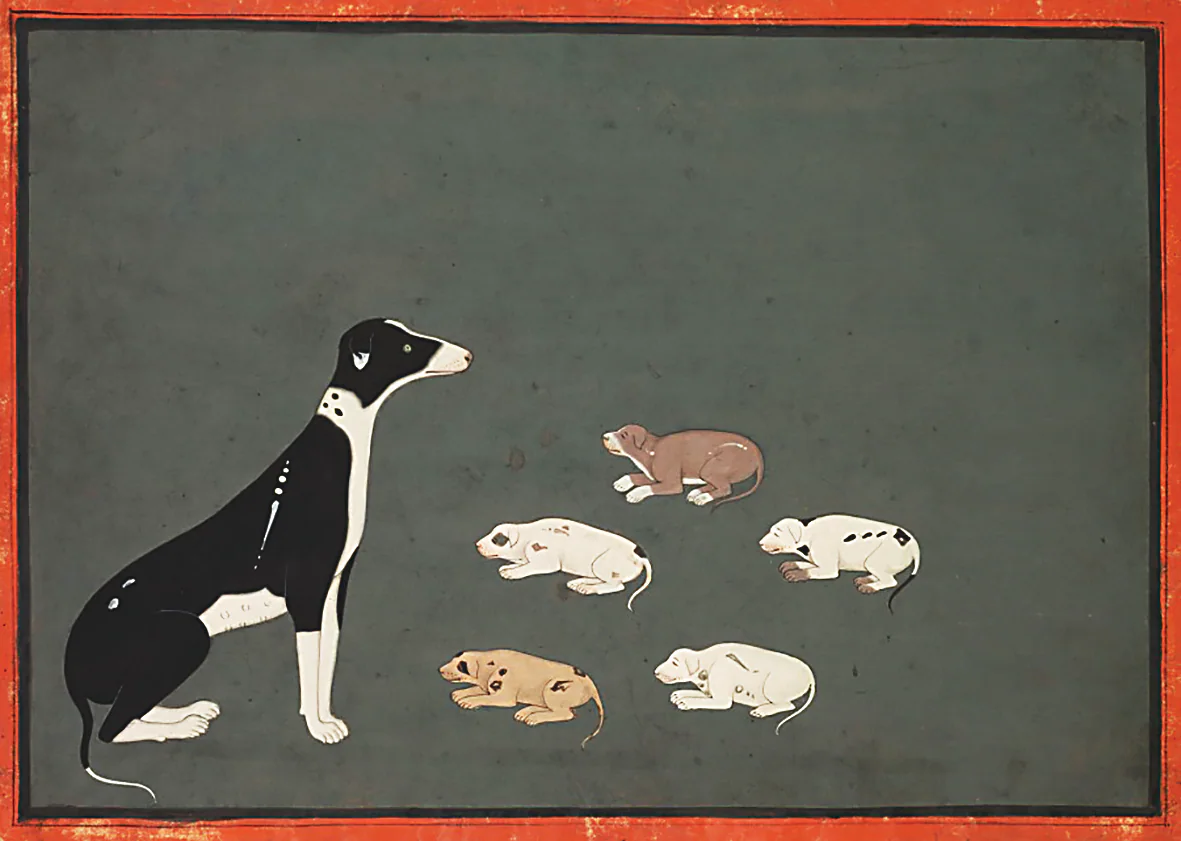
Created in the style of a court portrait, this Rajasthani miniature depicts a mother hound and her litter in intricate detail. The intriguing minimalism gives the artwork a timelessness and universality that make it hard to instantly pin down to an era or even a culture.
The message is clear, though: These are dogs that occupy an elevated position in their world. This is something the courts of Rajasthan famously had in common with the Mughal palaces of the time.
The Mughals typically pampered their hounds, with a ratio of one keeper for every two canines. Emperors imported prized breeds. Jahangir (r. 1605-1627) even asked English ambassador Thomas Roe to send a few over from his country.
This Rajasthani artwork, likely from the Sawar school, it is now on display at the Cleveland Museum of Art.
.
* ARTEMIS (DIANE), 2nd century CE; Italy

This sculpture depicts the Greek goddess of the hunt reaching for an arrow from her quiver, a bow in her left hand, accompanied by a small hunting dog that looks devotedly up at her from a position at her feet — in an expression anyone who has ever had dogs will recognise.
The artefact is a 1,900-year-old Roman replica in marble, of a lost Greek bronze.
It is unusual in its stillness; most depictions of Diane tend to involve rushed movement. Her canine companions are usually depicted as active predators.
What were the stiller moments like? This offers an answer.
The sculpture is currently on display at the Vatican Museums.
.
* DOG’S FACE by Edvard Munch; 1927; Norway

The Modernist master kept several pets, and this is one of them, immortalised but not named either in the work or in records relating to it. The painting’s raw, energetic, Expressionist brushstrokes render emotion over realism: zoom out and one sees a canine that has just had its interest piqued.
One of many intimate portrait Munch created of his dogs, this one suggests a moment of quiet, affectionate observation.
That wasn’t the mood that permeated Munch’s relationships with all canines.
He had a running feud with a dog named Rolle, who lived (and raged) down the road from his home in Oslo. Munch and the boy who delivered milk were both bitten in the leg by this “utterly dangerous” animal, the artist noted in his diaries. A police report saw the neighbour, a Mr Gunnerud, ordered to muzzle the dog. This became the subject of a dramatic, long-running dispute. (Click here to see Munch’s portrait of that canine, Angry Dog; among other works that didn’t make it to this list.)
Dog’s Face and Angry Dog both reside at the Munch Museum in Oslo.
.
* THE OLD SHEPHERD’S CHIEF MOURNER by Edwin Landseer; 1837; England

In this exquisite work, a border collie rests its head and chest against the draped coffin of its deceased master. Its mixture of pathos and realism come partly from Landseer’s masterful use of on chiaroscuro, the dramatic contrast of light and shadow, which directs the viewer’s eye immediately to the halo-like light at the centre of the frame.
Time spent on the recessed details is rewarded too, though. In the dimly lit corners are signs of the life this animal and its human shared: a hat, a walking stick, a chair, now empty.
The emotions of the frame resonated so widely that engravings of it sold widely (some accounts list the number at “tens of thousands”) in the year after the canvas was unveiled at the Royal Academy. The original is now at the Victoria and Albert Museum in London.
.
* THE PIANO by Pablo Picasso; 1957; Spain

Picasso’s beloved dachshund Lump appears in 15 canvases, usually depicted with a brazen outward gaze and bright eyes. The eyes stand out perhaps most prominently in The Piano, says Laqueur. They make the dog the most recognisable entity in the Cubist scene. The canine also serves to highlight the quiet domesticity of the work, which despite its flattening and distortion simply depicts a woman playing a musical instrument on a quiet day.
The painting is at the Picasso Museum in Barcelona.
,
* A PALACE CONCERT; hanging silk scroll; c. 8th century; Taipei
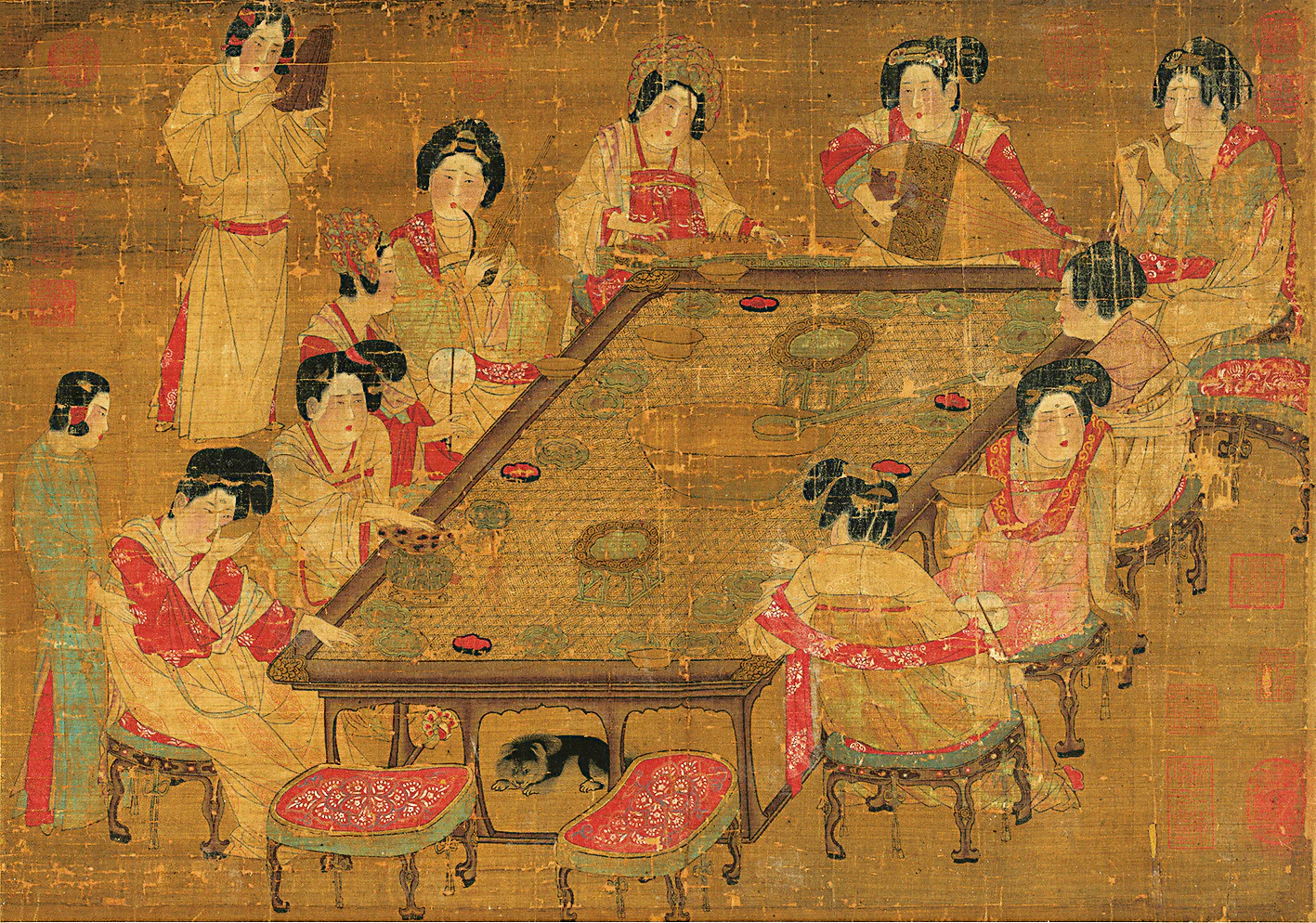
Ten ladies of the imperial court sit around a large table, with two maidservants standing in attendance. Some of the women drink tea, while others drink wine. Four women at the far end play musical instruments. One of the maids operates a clapper as accompaniment. Amid this scene of women at leisure, a small dog rests peacefully beneath the table.
Based on the clothing, hairstyles, woven-bamboo-top table and cusped crescent stools, winged wine cups and lute-playing technique, the silk scroll has been dated to the Tang dynasty.
It is housed at the National Palace Museum in Taipei.
.
* ROCK PAINTING OF A DINGO; c. 15,000 BCE; Australia
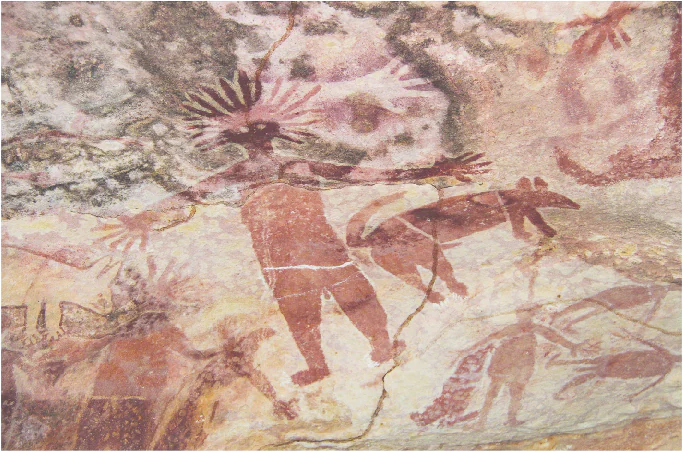
In Aboriginal lore, dingoes are woven into kinship systems, songlines and creation narratives. In prehistoric times, they were integrated into family and camp life, serving as hunting partners, bed-warmers, and guardians who helped ward off malevolent spirits and intruders at night.
This intricately carved scene of a human and their dingo sits in the Laura assemblage of rock shelters in Queensland.
.
* PUPPY FROM THE STUDIO OF TAWARAYA SOTATSU; early 17th century; Japan
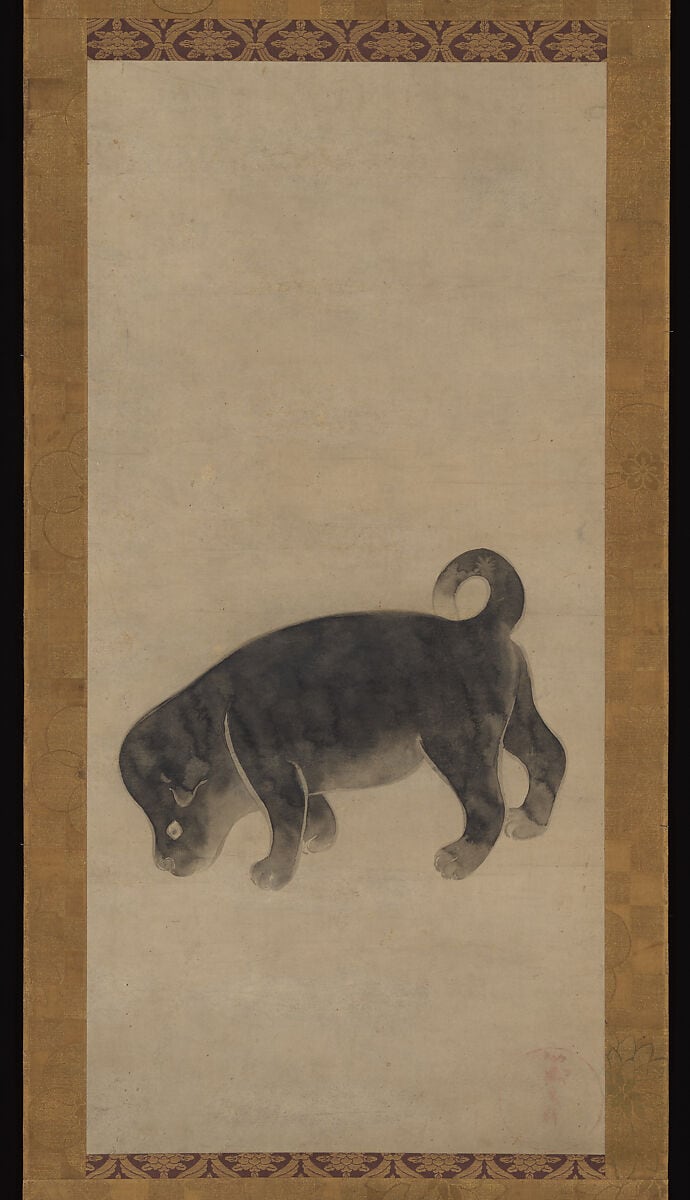
The softness of this rendering is almost palpable, yet closer examination reveals intricate details. The legs, paws and mouth are filled in with full, moist lines, employing the tarashikomi technique in which ink or paint were applied while a previous layer of such material was still damp, causing the two to blur and merge.
The technique was an interesting subversion of the hyper-precise Chinese ink traditions.
This work is an unusually quiet one for Sotatsu, known for brightly coloured compositions on floral or arboreal themes.
It is currently at the Metropolitan Museum of Art in New York.
.
* SEATED DOG AT THE TOMB OF NEBAMUN; 1350 BCE; Egypt
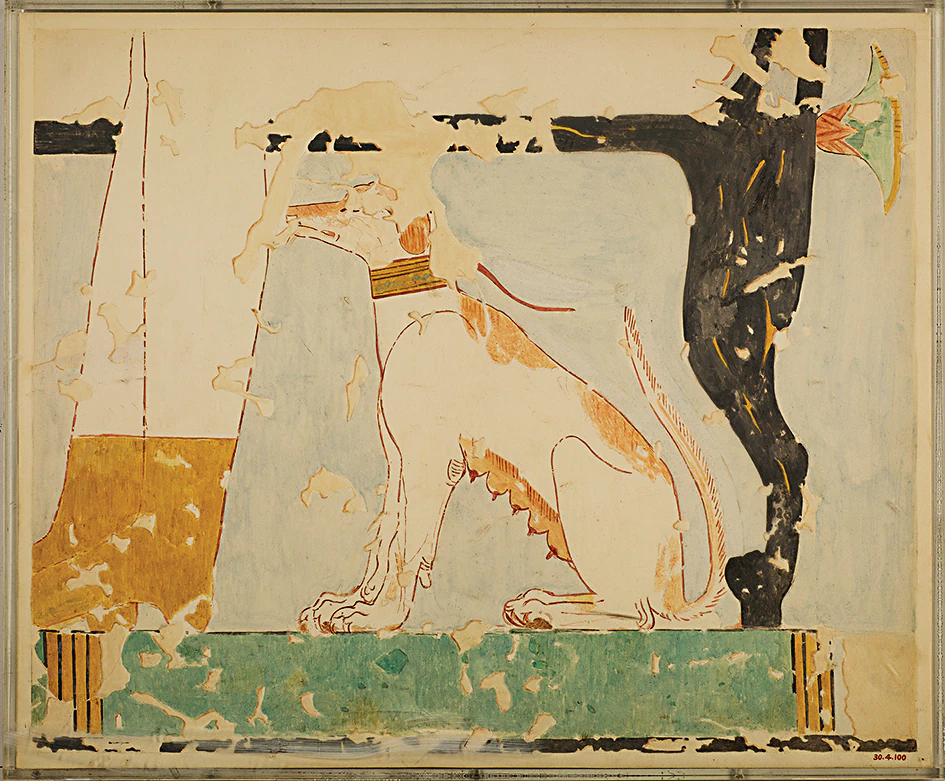
In this 1925 facsimile of a tomb painting (Nebamun was a respected scribe and grain counter), a female dog sits attentively beneath her master’s chair, in a scene of peaceful domesticity.
In Ancient Egyptian culture, dogs were pets, hunting companions, and served as guides through the afterlife. They were also status symbols, their pampered aspect reflecting the wealth, lifestyle and social standing of their masters.
Including the canine in tomb art suggests that the master, Nebamun, would have wanted to be bonded with her through eternity.
The facsimile is at the Metropolitan Museum of Art in New York.
ABOUT THE AUTHOR

Explore the latest Lifestyle News on health, fashion, travel, relationships, food and festivals. Find useful tips, expert advice, trends and inspiring stories for everyday living.