
 E-Paper







Shashank Rao is a Senior Assistant Editor having worked for over two decades. He reports on Mass Transportation including Railways and Roadways, Automobiles besides Urban Public Infrastructure. With ear to the ground, he is monitors and reports Mumbai's growth trajectory. He is a Rail fan, passionate about Public Policy. When I'm not busy, I read comics and watch anime and football.
BEST needs 13,000 buses, but 25 hybrid fleet buses lie idle for 20 months
BEST general manager Sonia Sethi said the requirement of 13,000 buses had been calculated using the Union housing and urban affairs ministry’s benchmark of 60 buses per 1 lakh population
Published on: Nov 24, 2026, 07:52:10 IST


Share via
Copy link
MUMBAI: The city needs a fleet of 13,000 buses to meet its public transport requirements, but the Brihanmumbai Electric Supply and Transport (BEST) Undertaking is grappling with delayed procurement, rising wet-lease costs and poor utilisation of its existing fleet, with 25 hybrid buses lying idle for the past 20 months. The twin challenges have brought the undertaking’s fleet planning under scrutiny as it prepares a major overhaul under its proposed ‘Kayapalat’ revamp.
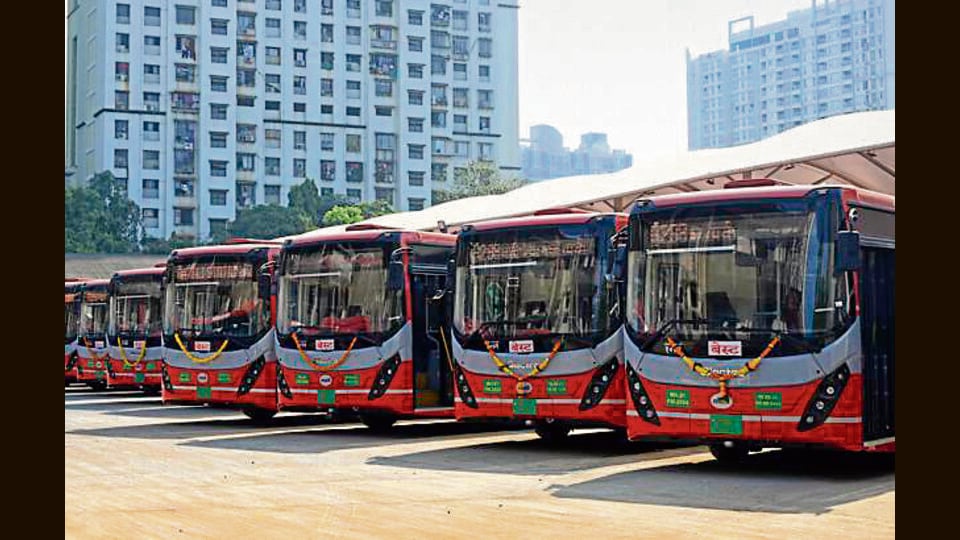
BEST general manager Sonia Sethi said the requirement of 13,000 buses had been calculated using the Union housing and urban affairs ministry’s benchmark of 60 buses per 1 lakh population. The undertaking currently operates around 2,877 buses and aims to expand its fleet to 10,000 over the next four years.
“Kayapalat of bus depots is not the sole solution. As per our fresh projections, Mumbai needs 13,000 buses for its population. The wet-lease model was introduced on the grounds that it would be financially beneficial. However, now that the majority of the fleet is on wet lease, we have seen that the outflow is more than the inflow. There is a need for a performance audit of existing wet-lease operators and a review of their contracts,” Sethi said. The administration is also planning to recruit around 200 assistant traffic officers (ATOs) to supervise the expanding fleet. BEST currently has 101 ATOs overseeing nearly 2,900 buses, with officials saying the existing strength is stretched. The additional personnel will monitor punctuality, staff deployment, depot operations, passenger complaints and route management.
Meanwhile, 25 diesel-electric hybrid air-conditioned buses, introduced in March 2018 to connect Bandra and Kurla through the Bandra-Kurla Complex (BKC), have remained grounded at Dharavi and Kalakilla depots. BEST committee member Sunil Ganacharya (BJP) said the buses had developed technical problems and procuring spare parts had become difficult. Despite remaining off the roads, BEST continues to spend around ₹20 lakh annually on their insurance. The viability gap funding for the buses also remains outstanding, sources said.
The fleet’s condition is particularly concerning as commuters face waiting periods of 20-40 minutes on several routes. Ganacharya said nearly 10% of BEST’s approximately 2,800-bus fleet was off the roads for repairs, while daily ridership had fallen to around 22 lakh.
Electric bus procurement has also encountered hurdles. Of the 4,500 electric buses contracted to Olectra in two phases, only around 700 have been delivered, leaving 3,800 pending. The manufacturer has sought a rate revision for the first batch of 2,100 buses, citing financial difficulties. The subsidy arrangement for the remaining 1,100 buses is also under consideration, with the matter referred to the Attorney General for legal clarity.
BEST received state government approval in July to procure another 5,000 air-conditioned electric buses at an estimated cost of ₹6,500 crore, with deliveries expected over the next two to three years.
Ganacharya also questioned the undertaking’s procurement and financial planning, pointing to its 17,825 employees against just 249 owned buses. He alleged that a 2019 memorandum of understanding envisaging 3,337 owned buses had not been honoured.
With the BMC providing around ₹1,000 crore annually against BEST’s projected requirement of more than ₹5,000 crore for new bus procurement, funding remains a major constraint. Committee members also flagged poor coordination with the Mumbai Metropolitan Region Development Authority (MMRDA), which they said had contributed to the hybrid buses remaining unused.
The issue has implications for BKC, which attracts an estimated 500,000 to 6,05,000 people daily, including around 200,000 working professionals on weekdays. BEST currently operates 125 buses across 16 routes serving the business district.
ABOUT THE AUTHOR
Catch every big hit, every wicket with Crickit, a one stop destination for Live Scores, Match Stats, Infographics & much more. Explore now!
Stay updated with all the Breaking News and Latest News from Mumbai. Click here for comprehensive coverage of top Cities including Bengaluru, Delhi, Hyderabad, and more across India along with Stay informed on the latest happenings in World News.











