
 E-Paper




Vande Mataram rendition at J&K Waqf event sparks row
Mirwaiz Umar Farooq-led Mutahida Majlis-e-Ulama (MMU) on Wednesday and condemned the ‘growing imposition’ of the song in J&K, saying its lyrics were against Islamic religious beliefs.




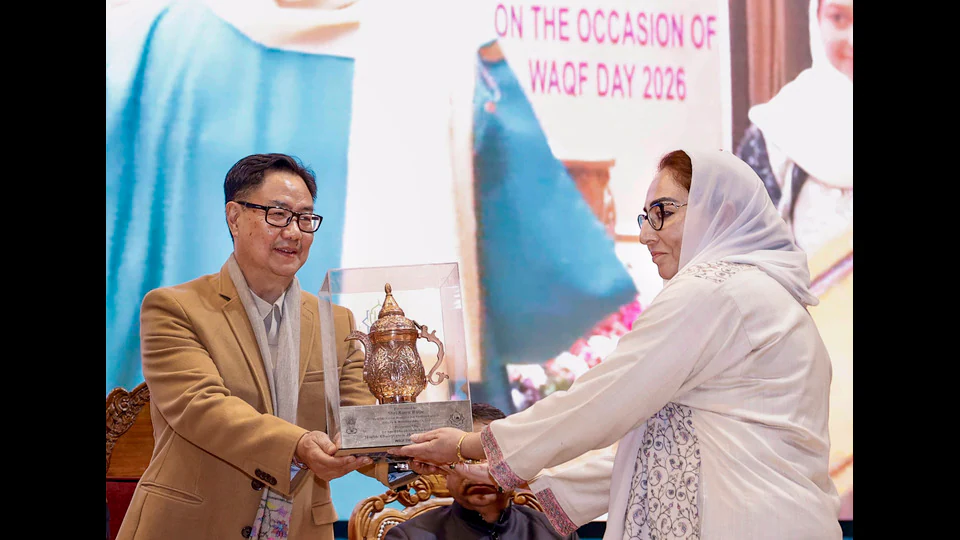
The playing of the national song, Vande Mataram, at the Waqf Day ceremony in Srinagar on Monday has triggered a controversy, with several clerics expressed repentance for attending the event organised by the J&K Waqf Board.
Mirwaiz Umar Farooq-led Mutahida Majlis-e-Ulama (MMU) on Wednesday and condemned the ‘growing imposition’ of the song in J&K, saying its lyrics were against Islamic religious beliefs.
Union minister Kiren Rijiju had attended the inaugural Wakf Day event at the Convention Centre of the Sher-e-Kashmir University of Agricultural Sciences and Technology of Kashmir (SKUAST-K). Anantnag MP Mian Altaf and J&K Waqf Board chairperson Darakshan Andrabi were also present. Several clerics associated with the Waqf mosques and shrines had also attended the event.
The Union home ministry’s January 28 directive mandates the playing or singing of all six stanzas of ‘Vande Mataram’ before the national anthem, Jana Gana Mana, at a raft of official occasions, including during the unfurling of the Tricolour, the arrival of the President at events, before and after the President’s speeches and addresses to the nation, and before and after the arrival and speeches of governors.
The MMU, an amalgam of major Muslim religious organisations in Jammu and Kashmir, has maintained that singing or reciting Vande Mataram is “un-Islamic”, as it contains expressions of devotion that contradict the fundamental Islamic belief that Allah is one (‘Ahad’ in Arabic).
Following the backlash after the videos of the event went viral on social media, a group of clerics, many from Jammu, addressed a press conference in Srinagar and expressed repentance for attending the event.
“We won’t go into the details, but during the event, there was something which was against the Shariah, and we are repenting for the mistake . As soon as the event ended, we realised our mistake in attending the event. This should not be given a sectarian colour because scholars of every sect were present there,” said a cleric.
The MMU on Wednesday said that Islam strictly prohibits associating any partner with Allah or attributing divinity to any person, object, land or creation.
“While Islam encourages love for one’s homeland, it draws a clear distinction between love for one’s homeland and its worship or deification. Any expression or practice that attributes divinity to the motherland is contrary to the fundamental Islamic belief of Tawheed and is, therefore, un-Islamic and impermissible for Muslims,” it said in a statement.
It pointed out that the All India Muslim Personal Law Board (AIMPLB) has also categorically clarified the Islamic position on Vande Mataram and strongly opposed its compulsory rendition on both religious and constitutional grounds.
“It is highly regrettable and unacceptable that Vande Mataram was played at a function organised by the Waqf Board itself, an institution entrusted with safeguarding Muslim religious endowments and their sanctity. There was no legal obligation to play Vande Mataram simply because it was an official function, and playing it was optional. Yet the Waqf Board went ahead with it with utter disregard for the fundamental religious beliefs and sensitivities of Kashmiri Muslims, which has caused deep hurt and anguish among people,” it said.
The MMU said that, in view of the growing seriousness of the issue, it was seeking legal opinion and would also submit a formal representation to the concerned authorities, seeking an immediate end to the forcible imposition of Vande Mataram at government functions, educational institutions and other public events in Jammu and Kashmir.











