
 E-Paper




Lawmakers discuss constitutional values, devp in Haryana assembly
The Speaker asked Kadian not to deviate from the subject. Chief minister Nayab Singh Saini also urged the opposition MLAs not to stick to the topic. Pointing to the Congress benches, Saini reminded who the founder of the Congress was, stating that even Mahatma Gandhi proposed disbanding the Congress after India attained independence




Amid mild bickering and disagreements, lawmakers from the ruling BJP and the Opposition Congress on Thursday spoke at length on constitutional values and state’s development trajectory during the day- long special session of Haryana assembly. The special session was convened to mark Constitution Day.
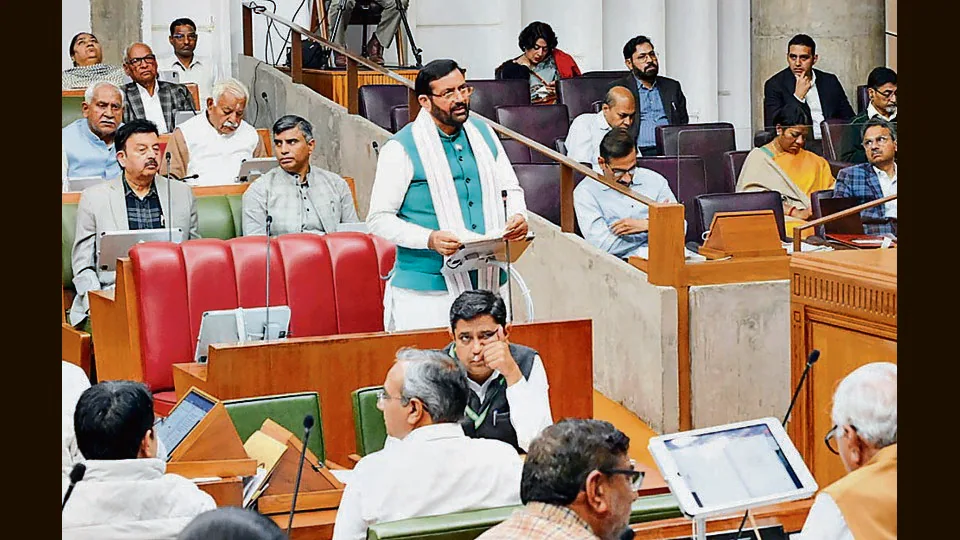
Congress MLA, Raghuvir Singh Kadian who spoke first from the opposition benches made certain remarks with reference to the RSS but was asked to refrain from doing so by the Speaker, Harvinder Kalyan.
The Speaker asked Kadian not to deviate from the subject. Chief minister Nayab Singh Saini also urged the opposition MLAs not to stick to the topic. Pointing to the Congress benches, Saini reminded who the founder of the Congress was, stating that even Mahatma Gandhi proposed disbanding the Congress after India attained independence.
Congress Legislature Party (CLP) leader, Bhupinder Singh Hooda said if the Speaker was asking Kadian to stick to the subject, then the same rule should apply to the ruling party MLAs also.
Kadian said that until a decade ago, fingers were never pointed at the constitutional bodies. “But it is happening now,” he said. The Congress MLA said the manner in which attempts are being made to gain control over the functioning of the autonomous bodies is a cause of deep concern. “Samvidhan Raksha marches are being held across the country. Why have things come to this,” he asked.
State energy minister Anil Vij during his address targeted the Congress saying the opposition which claimed that the Constitution was under threat should explain who actually had undermined the spirit of Constitution and democratic institutions. Vij said the country had witnessed a period when democratic rights were violated, citizens’ voices were suppressed and the spirit of the Constitution was deeply hurt. Referring to the Emergency imposed in 1975, he said that citizens’ rights were curtailed, the press was subjected to censorship, and leaders and workers of opposition parties were imprisoned. He said that during that period, even expressing one’s views had become difficult and people were denied the freedom to speak.
Leader of Opposition Hooda said that the Constitution was not merely a book, it was the nation’s soul.
Hooda said there was a need to keep our institutions like Election Commission, media autonomous because if any one of these become weak then democracy cannot survive. “If democracy does not survive, the constitution will not survive. And this country won’t be there,” Hooda said.
Saini in his address said that the Constitution was the guiding force for our present and future. Over the past 77 years, the Constitution has shown the country the right path in overcoming every challenge. Respecting the Constitution is not the responsibility of any one political party or government, but the duty of every individual whom the people have entrusted with the opportunity to serve them, Saini said.
The CM said it was a matter of pride that seven eminent personalities from Haryana — Captain Ranjit Singh, Pandit Thakur Das Bhargava, Rao Bahadur Chaudhary Suraj Mal, Pandit Shri Ram Sharma, Master Nand Lal, Chaudhary Ranbir Singh Hooda and Lala Deshbandhu Gupta — contributed to the deliberations of the Constituent Assembly. The CM said that while commemorating this significant occasion, everyone must also remember that November 26 marked the anniversary of the 2008 Mumbai terror attack.
Saini said that the first meeting of the Constituent Assembly was held on December 9, 1946. After nearly three years of deliberations, the Constitution was adopted on November 26, 1949. At that time, it comprised 395 Articles, 22 Parts and 8 Schedules. The Constituent Assembly deliberated on several important issues during its 11 sessions, while thousands of amendments proposed to the draft Constitution were given serious consideration. During this extensive process, the voices of every section of Indian society and every region of the country were heard. The framing of the Constitution was not merely an exercise in preparing a document, but a powerful endeavour to find a path of consensus, dialogue and democratic decorum for a nation marked by immense diversity.
“The Constitution was not the creation of any one individual, but the outcome of the collective wisdom of the Constituent Assembly and the collective aspirations of the nation. On January 24, 1950, 284 members signed the Constitution, bearing testimony to India’s democratic commitment,” he said.











