
 E-Paper






Vishal Mathur is Technology Editor for Hindustan Times. When not making sense of technology, he often searches for an elusive analog space in a digital world.
OpenAI Dots is a bright companion, and Google Willow plays an impossible game
The biggest AI conversations, decoded. 25 November 2026
Published on: Nov 25, 2026, 08:00:31 IST


Share via
Copy link
A slightly different format (again, hope you’re liking the flexibility) this week. Our artificial intelligence conversation will focus on two key aspects. One is an important development from this week, and another is decoding an AI capability that could save you a lot of time and effort every day. We chat about OpenAI’s Dots, the background assistant that can do multi-step jobs, has its own computer on the cloud for compute, and can work with more than 4,000 apps for context. We also chat about a recent study published by Google Research, in which scientists played a more difficult than it seems at first “magic square” game on their Willow quantum processor—and won 98.3% of the time.
PREVIOUSLY, ON NEURAL DISPATCH: India’s strategic blueprint, challenging AI’s financial sustainability: AI views from HTLS 2026
GETTING AN OPENAI DOT READY
In late September, OpenAI announced something called Dots. Foremost, these always-on agents immediately begins to tackle a contradiction on the AI pitch as it is being sold to us: the fact that AI will save us a lot of time, but we still spend a lot of time explaining or correcting AI. Good start. Secondly, the fact that OpenAI Dots is underlined by the GPT-6 Astra and the GPT-6.1 Terra models (the latter arrived in November with alignment improvements), gives that proactiveness focused flexibility and frugality when that can be managed.
Every Dot begins its interaction with a different approach. Unlike the browser or app-based prompt-first methodology that AI chatbots work with, it is an autonomous background worker once you’ve told it what to do. Each Dot operates on its own dedicated cloud computer (you can access that as well within the app for instance; speaking of which, the redesign looks nice), a sandboxed browser, and can connect with over 4,000 apps (how many you get around to, depends on your comfort level and trust factor).
Here’s a snapshot of what it can do: Dots can save time by removing that hopping between applications, manual tasks and eliminating repetitive context-setting. Proactive research is one way to put it, with a Dot continuously scanning for any new information about the content it is working on, or with connected calendars, inboxes, and workspaces in the background. It will flag those updates such as when a deadline shifts or when preparing morning briefings. If a user gives it permission through the ChatGPT desktop app, it can also bridge into a user’s machine to access files or run local Codex tasks.
I stress-tested Dots as a journalist tracking developments across the technology industry. A detailed prompt to get this set up was all that was really needed (it needs the context of which beats or domains to keep an eye on, any specific sources of information, and the window of time), the dot I set up began with daily 7am briefings on putting together the important developments of the past few hours (as it was late night IST). Nothing groundbreaking, one could say, but it saves more than a few minutes of manual searching every morning to achieve the same information spectrum.
It is not without occasional foibles. Once, the 7am briefing arrived at 10am without any specific reason, but that hasn’t happened since. Often, the briefing tends to lean a bit too much towards certain topics, and some prompting along the way tweaks that behaviour.
Most appreciated are the follow-ups: Dots picked out an article I had written about three months ago for HT (I never pointed it to my author page or shared any personal-professional details), and gave me an update stating that the company and product I had written about at that time, had since updated the terms and conditions document to reflect a new change. At another time, it pointed out that there had been a price change for a review done a few weeks ago.
This is just one example. Dots can be handy to create a morning briefing dashboard for you with calendar, emails, messages and documents for context—and pick out what should get more of your attention that day. Or keeping track of an ongoing project in terms of timeline and what’s been done. Or setting it up to research a defined source list and tracking updates or changes as they happen. Or even to connect an email inbox and ask the Dot to classify messages by urgency, extract requests, and draft replies in your preferred style.
Unfortunately, none of this comes without having to part with a fair share of money. Dots for India is currently behind the OpenAI ChatGPT Pro subscription that is priced upwards of ₹10,699 per month (that’s ChatGPT Pro 100). Personal users can set up one dot per eligible account. That brings us to the point of the broader ecosystem.
Last week, Google expanded Tasks in Gemini, a agentic feature in the Gemini app that runs multi-step jobs and recurring routines in the background, to be available for free in India, US, Japan, South Korea, Canada, and Australia. It can do a lot of what ChatGPT Dots can do, and even for Gemini free-tier users. There’s of course more for paid users, such as Personal Intelligence context across Google apps and Workplace tools, if that’s needed.

To test this, I set up the same morning briefing dashboard in Tasks, and results are at par—on no occasion did Tasks either give an inferior update in terms of quality or width of developments in the tech space, nor did it ever simply forget. That said, I must warn that your mileage may vary depending on complexity of tasks—there are some things that Dots will certainly do better. And from what I gather from my experience, you aren’t limited to setting up one task only.
🤖DISTILLING AI PROGRESS FROM THIS WEEK
📖OpenAI reveals internal pretraining metrics, wants an AI speed limit
📖Meta’s AI chief talks about superintelligence, even as Muse models trail rivals
📖Nvidia and AMD cleared for massive AI chip exports to China, disclosure reveals
ONLY A QUANTUM COMPUTER CAN WIN THIS
Since games are in vogue this week, let’s try this quick puzzle instead of GTA VI for a moment. Draw a 3×3 grid and fill every square with either a +1 or a -1. There are just two rules: every row has to multiply to +1, and every column has to multiply to -1. You’ll quickly realise, you’ve hit a wall. For a row to multiply to +1, it needs an even number of -1s. For a column to multiply to -1, it needs an odd number of -1s in parallel. That means the grid simultaneously needs an even and an odd total number of -1s. It is a mathematical paradox—no such grid can exist.
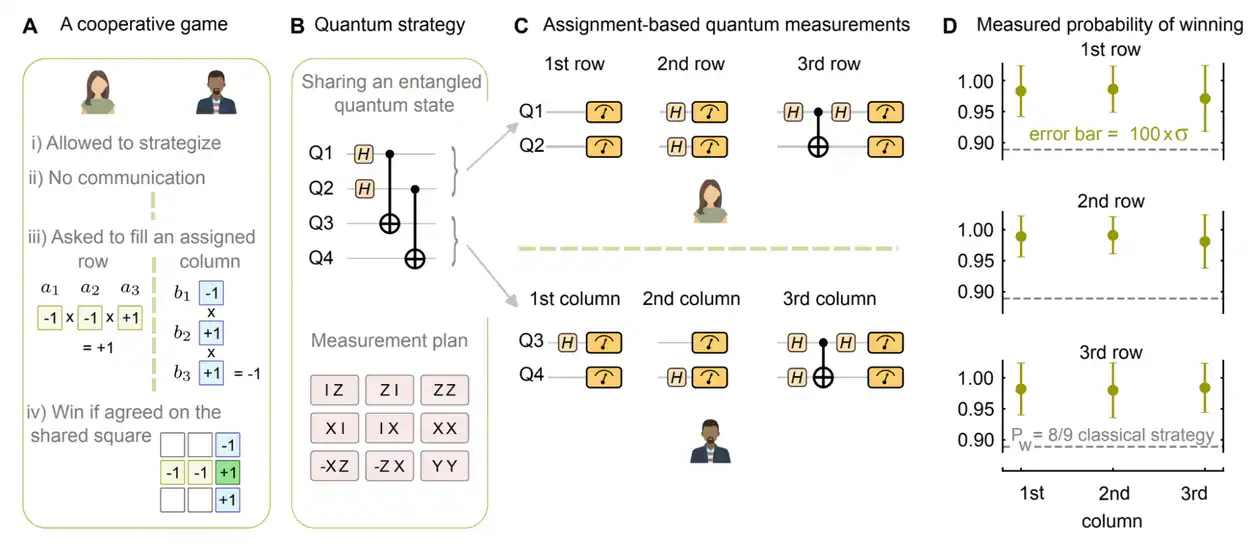
Now, turn that impossible grid into a game. Imagine two players, Alice and Bob, who are not allowed to communicate. A referee gives Alice a random row to fill out, and Bob a random column. They win a round if they put the exact same number in the single square where their row and column overlap. Even with the smartest pre-arranged cheat sheet, classical logic guarantees they will lose at least one out of every nine rounds, capping their maximum win rate at 88.9%.
Unless, of course, they bring a quantum computer.
In a recent study published by Google Research, scientists played this exact “magic square” game on their Willow quantum processor—and won 98.3% of the time. They didn’t pull this off by magically forcing the impossible grid to exist. Instead, they tapped into an often-debated rule of quantum mechanics: quantum contextuality.
Decades ago, Albert Einstein famously asked whether the moon is still there when nobody is looking at it, arguing that physical objects must have fixed properties whether we measure them or not. Contextuality is physics’ way of saying not necessarily. At the quantum level, particles don’t carry pre-written answers that are waiting to be read. Instead, any measurement’s outcome exists the moment you observe it, with the context of whatever else is being measured alongside.
“Entanglement usually gets top billing as the “magic ingredient” of quantum computing. But a growing body of theory suggests contextuality is the deeper resource, the thing that actually powers certain quantum algorithms past their classical counterparts. The catch is that, until recently, contextuality had been demonstrated almost exclusively in small systems of a few particles. Whether it survives, and stays useful, in the many-body systems that real quantum computers are made of was an open question,” say Shashwat Kumar and Rodrigo Cortiñas, Research Scientists, Google Quantum AI, Google Research.
To compute, traditional computers store information in bits (that is, 0 and 1). Quantum computing is built around qubits that do both at the same time (a bit like Shrodinger’s cat). Quantum computers use qubits, which can represent 0, 1, or a combination of both simultaneously.
By sharing entangled qubits, Alice and Bob’s quantum systems coordinated their answers on the fly, beating every classical limit.
While entanglement usually steals the spotlight as quantum computing’s secret sauce, theorists have long suspected contextuality is the deeper engine powering quantum advantage. The catch was proving it actually survives inside large, noisy quantum machines rather than just isolated pairs of particles.
Google’s team showed it does—and at a serious scale. Beyond scoring 5.59 out of a theoretical maximum of 6 on a direct “contextuality meter” (well past the classical limit of 4), they scaled their experiments up to a 71-player quantum parity game and solved a complex hidden-linear-function problem across 105 qubits.
Even better, these quantum mind-games turned out to be an unexpectedly sharp diagnostic tool. Because the puzzles demanded strict, simultaneous agreement across dozens of qubits, they exposed subtle hardware glitches that standard random benchmarks completely missed. In trying to win an impossible game, scientists didn’t just settle an old philosophical debate—they built a better ruler to measure the future of quantum computing.
“A nearly century-old argument about whether physical systems always exist when nobody looks turns out to have a measurable test. For our qubits, the verdict is clear: not everything we measure can have pre-existing values waiting to be observed,” the scientists say, adding that measuring contextuality across many qubits lets us probe an open question in physics and computer science on real hardware is what gives quantum computers their edge.
The latest, on Wired Wisdom: The really simple home air purification guide
ABOUT THE AUTHOR

Get instant updates on daily movements in Gold Price and Silver Rates, Petrol Price, and Diesel Rates and essential financial indicators. Explore in-depth Business News and analysis on policy changes, income tax rules, and key economic developments across India and worldwide.











