
Researchers dyed Peter Lake in Michigan’s Upper Peninsula blue during a 2004 experiment designed to investigate how limiting sunlight affects algal growth. They added a blue water dye to reduce light penetration and then introduced fertilizers to encourage algae to multiply. According to Danny Szydlowski’s account published by the Midwest Climate Adaptation Science Center in January 2025, repeated rainfall may have diluted and washed away the dye, allowing more sunlight to reach the water. The experiment showed how difficult it can be to control algal growth in natural freshwater ecosystems.
Two neighboring lakes provide a natural comparison
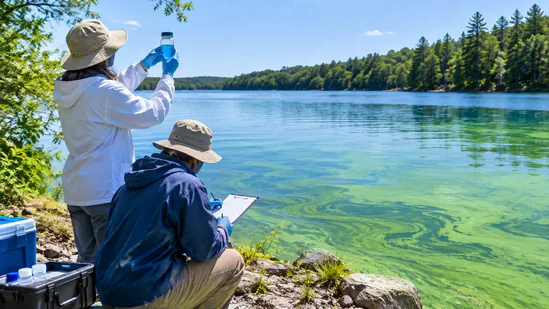
Peter Lake is one of the sites in the long-term Cascade Project studying the response of lakes and freshwater ecosystems to environmental change. It sits next to Paul Lake, from which it is separated by a thin land bridge. Paul Lake has served as a reference lake for the project, while Peter Lake was used for whole-lake experiments, allowing for an assessment of experimental manipulations against reference conditions in Paul Lake.
Suggested For You
Both lakes experience similar regional weather, making differences in their ecological responses useful for research. A 2011 study published in Science titled “Early Warnings of Regime Shifts: A Whole Ecosystem Experiment” investigated changes in ecosystem behavior as a sign of an impending ecological shift. Research suggested that an early warning signal can arise prior to a major change being observed.
Dye and fertilizer produce an unexpected result
A commercially available blue water dye called Aquashade was purchased for the 2004 trial with the intent to lower the amount of sunlight entering the lake. Algae require sunlight in the process of photosynthesis, so reducing the amount of light in the water would theoretically constrain the growth of algae. The dye was added to the water and mixed with an electric trolling motor.
{{/usCountry}}A commercially available blue water dye called Aquashade was purchased for the 2004 trial with the intent to lower the amount of sunlight entering the lake. Algae require sunlight in the process of photosynthesis, so reducing the amount of light in the water would theoretically constrain the growth of algae. The dye was added to the water and mixed with an electric trolling motor.
{{/usCountry}}A nutrient fertilizer was also added to the water to try to promote the growth of algae. A fertilizer with nitrogen and phosphorus is needed by plants in order to grow. At elevated levels, these nutrients can trigger algal proliferation by increasing nutrient availability while light remains sufficient for growth. But the effects on the lake were observed and recorded by the researchers.
A green algal bloom eventually occurred in Peter Lake, and the water turned green. It may have been that a few rain events had diluted and flushed the dye from the lake. Szydlowski suggested that, as the concentration of the dye decreased, it would have been possible for more sunlight to penetrate into the lake and allow the algae to grow. They were not certain about the cause and simply used the rainfall event as a possibility. However, it shows that weather can have a significant influence on the experiment.
Findings highlight challenges in lake management
Through this experiment, the influence of nutrient supply in freshwater in relation to light supply was elucidated, and the fact that regulation of a single parameter will often be inadequate to restrict algal blooms if other parameters facilitate growth was demonstrated. In 2017, research published in Proceedings of the National Academy of Sciences investigated whether early warning indicators might be useful for the detection of impending cyanobacterial blooms.
In an experimental lake, nutrient concentrations were gradually increased, and the lake's ecological responses were observed. When certain indicators reached preset thresholds, researchers stopped adding nutrients, slowing the development of a bloom. The Peter Lake experiment showed that dye is not a useful tool for stopping bloom formation. It also showed that lake-management experiments depend heavily on conditions in the lake being studied.
Explore More
ABOUT THE AUTHOR
The Hindustan Times US Desk brings you the latest news and developments from across the United States. The team covers everything from breaking news and politics to sports, business, entertainment and stories that are trending across the country. Our coverage includes the White House, Congress, US elections, immigration and visa updates, H-1B, green cards, Social Security, education, jobs, layoffs, the economy, technology and major policy changes. We also closely follow stories that matter to Indian and South Asian communities in the US. The desk covers major US sports, including the NFL, NBA, MLB and NHL, along with player news, injuries, schedules, results and major events. Entertainment coverage includes Hollywood, celebrities, television, streaming, music and pop culture. We also report on breaking developments, major incidents, weather, public safety, court cases and other stories making headlines across the country. When a major policy or news development affects people's everyday lives, the team works to explain what happened, what it means and what readers need to know. Alongside breaking news, the US Desk produces explainers and practical stories on topics such as immigration, Social Security, taxes, education, employment and government programmes. The team also works on science, tech, business and AI stories analyzing the impact they may have on people. The team follows developments throughout the day, keeping an eye on official announcements, public records, reliable news sources and what people are talking about across the US.
