Pennsylvania Races to Stem Measles Outbreak as Amish Wedding Season Draws Crowds
After a young woman’s death shook a tightknit valley, some families are reconsidering the MMR shot—while others still choose to let the illness run its course.
Published on: Nov 27, 2026, 08:38:17 IST
WSJ
Advertisement
BELLEVILLE, Pa.—As measles cut a path through unvaccinated swaths of Pennsylvania this summer, Jonas Kurtz made sure all seven of his children had received the two shots needed for immunity.
PREMIUM
Weekly cases in Pennsylvania’s measles outbreak, the nation’s worst, have declined since peaking in early September
{{^htLoading}} {{/htLoading}}
Since then, none has contracted the highly contagious disease. But several unvaccinated members of his extended family came down with the telltale rash and fever following a home wedding attended by hundreds. The host had apparently caught the virus at a horse auction in Lancaster County—the epicenter of the state’s
New Holland Sales Stables in Lancaster County hosts horse and livestock auctions. Many Amish gather in person for church, social events and business, helping to spread the virus.Jonas Kurtz, who grew up Amish but left the church with his wife, lives In Jefferson County, where reported measles cases rank third-highest in Pennsylvania.
Hundreds of state health employees are focused on ending the outbreak through vaccination and education campaigns, a toll-free hotline and tracing the close contacts of each reported case, according to Dr. Debra Bogen, Pennsylvania’s health secretary. “It’s all hands on deck,” she said.
{{^htLoading}} {{/htLoading}}
The outbreak—and the elaborate sprint to contain it—represents a new reality for a nation that for decades kept this vaccine-preventable disease at bay. The U.S. has reported more than 6,000 measles cases so far this year, the highest annual count in more than three decades, and lost its measles-elimination status earlier this month.
Pennsylvania’s outbreak is the latest in a string of historically large outbreaks in Texas, Utah, Arizona, South Carolina and Wisconsin since early 2025. Here, it has predominantly hit the Amish and Plain communities, though outsiders have fallen ill, too.
Since April, public-health officials have been racing to engage thousands in the Amish, Mennonite and other Plain communities scattered across more than 40 counties, many of whom have become increasingly wary of vaccines.
{{^htLoading}} {{/htLoading}}
A nurse at the Central Pennsylvania Clinic in Belleville handles the MMR vaccine.
Statements by Health Secretary Robert F. Kennedy Jr. have fed some of that hesitancy. In 2021, he played down measles’ risks to a crowd in Lancaster. More recently, he said the MMR vaccine contains “aborted fetus debris,” and he has questioned whether the disease caused the measles-associated deaths reported by the state. Last week, Kennedy called the vaccine the most effective way to prevent measles.
{{^htLoading}} {{/htLoading}}
Views on vaccination are mixed within the Amish and other Plain communities. There aren’t religious prohibitions against the practice, but many have preferred traditional remedies and developing natural immunity over medical interventions. Others have routinely opted to get the shots.
Their cultural beliefs also vary as widely as their buggy tops vary in color—gray, yellow, white and black. To reach them, Dr. Jennifer Wallace, who oversees Pennsylvania’s 59 state health centers, turned to pop-up vaccination clinics. Since May, she has organized more than 290 in fire halls, church basements and homes, administering 7,500 shots.
In southeastern Chester County, a firehouse clinic drew only a few dozen people in early August. Then, an Amish man phoned Dale Weiser, the county health department’s clinical-services supervisor, and asked her to bring vaccines to his home. Weiser and her colleagues vaccinated more than 100 people there over two days, she said. Word spread, and more than 50 households have since welcomed her in.
{{^htLoading}} {{/htLoading}}
“If you’re talking about a group of people who travel by horse and buggy,” Weiser said, “you have to go there.”
Belleville sits at the center of an area known as the Big Valley, its patchwork of farmland far from any major city or interstate.Dr. Jennifer Wallace, who oversees Pennsylvania’s 59 state health centers, turned to pop-up vaccination clinics to reach members of the Plain communities.
More cases are among adults, a rarity for what was long considered a childhood disease. Measles is also infecting unvaccinated pregnant women, raising risks for hospitalization, pregnancy loss and congenital measles, according to researchers from the Centers for Disease Control and Prevention.
{{^htLoading}} {{/htLoading}}
Earlier this week, at the Central Pennsylvania Clinic in Belleville, Dr. Katherine Mascia prepared to vaccinate two Amish families. Boxes of measles, mumps and rubella vaccines sat in a refrigerator in a barnlike, wood-timbered building decorated with quilts.
A geneticist who never expected to see a measles case, Mascia has explained in clinic newsletters that vitamin A doesn’t prevent measles and that natural infection carries serious risks, such as pneumonia and encephalitis.
Pennsylvania has reported more than 1,600 cases since April, including 209 in Mifflin County, home to the clinic and the state’s second-highest count. But Mascia says actual local cases could be “a hundred times” higher. Amish families typically lack health insurance, and some must hire drivers to reach a medical center, so many treat sick relatives at home, leaving cases unreported.
{{^htLoading}} {{/htLoading}}
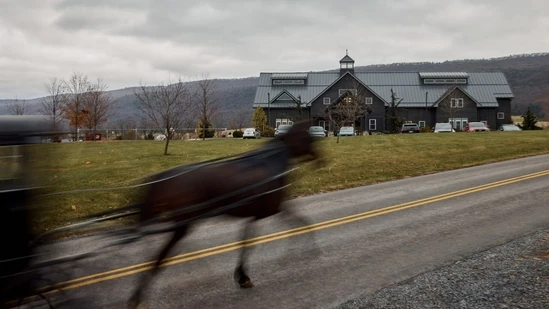
The area, known as Big Valley, lies between two long Appalachian ridges, its patchwork of farmland far from any major city or interstate. Laundry hangs from lines, and yellow- and white-topped buggies clop down single-lane roads. Girls in dresses and boys in straw hats play tag outside schoolhouses.
The clinic specializes in treating children with genetic disorders, and has built trust in part by meeting with families for an hour each visit. More have come to accept the MMR vaccine as the disease has spread, and disrupted harvest and other manual work. After the measles-associated death of an 18-year-old woman in September, sign-ups to receive shots at the clinic jumped from 25 to 70.
Vaccination literature at the Central Pennsylvania Clinic.Dr. Katherine Mascia, a geneticist.
Opinions still vary house by house over whether to get vaccinated or let the disease provide its own immunity.
{{^htLoading}} {{/htLoading}}
Korie Yoder, a produce farmer, chose not to vaccinate his family, and three of his children were inside a white farmhouse fighting off the disease.
His four other children had already recovered; his wife had measles in 1988. Yoder himself suffered through a bout about three weeks ago and traveled to a clinic for an IV. “I was down for a couple weeks,” he said. “The last are down with it right now.”
His neighbor, Sam Peachey, a florist with a pick-your-own flowers farm, said he, his wife and their five children have long been vaccinated for measles.
“Churches encourage us to keep our opinions to ourselves,” he said. “We’re not scared of the vaccine, but a lot of people are.”
Peachey doesn’t believe the outbreak is slowing. “Oh, it’s still happening,” he said. “It’s still wedding season, so a lot of people are being exposed.”
Sam Peachey, whose family is vaccinated against measles, says the outbreak is ongoing: ‘It’s still wedding season, so a lot of people are being exposed.’
In Big Valley, many believe a single person brought the virus back from the regular horse auction in New Holland, in Lancaster County, the hub of a settlement of roughly 45,000 Amish.
Taking a break at the machine-repair shop he runs behind his home, Allen Hoover, an Old Order Mennonite and a former administrator at the Parochial Medical Center in New Holland, said the pandemic undid much of the recent progress on vaccine acceptance. His family is vaccinated, but six children across the road got measles, with none of the cases reported.
Three of their adult siblings vaccinated their own children after seeing the disease’s effects, but Hoover doesn’t think many people have changed their views. Locals say attendance at the horse auctions, where hundreds of bidders sit together for hours, hasn’t dropped.
Cases still pop up locally, but Hoover thinks the worst has passed.
“We had a wave that was vastly underreported,” he said. “There weren’t enough daughters to go around helping people.”
BELLEVILLE, Pa.—As measles cut a path through unvaccinated swaths of Pennsylvania this summer, Jonas Kurtz made sure all seven of his children had received the two shots needed for immunity.
PREMIUM
Weekly cases in Pennsylvania’s measles outbreak, the nation’s worst, have declined since peaking in early September
Since then, none has contracted the highly contagious disease. But several unvaccinated members of his extended family came down with the telltale rash and fever following a home wedding attended by hundreds. The host had apparently caught the virus at a horse auction in Lancaster County—the epicenter of the state’s outbreak.
“That’s how it spreads in the Amish world,” said Kurtz, who grew up Amish outside Punxsutawney but left the church with his wife over a disagreement about their faith.
Weekly cases in Pennsylvania’s measles outbreak, the nation’s worst, have declined since peaking in early September. But health officials don’t believe community spread is yet under control. They now worry that large gatherings such as winter weddings—often held after harvest and with guests from other counties and states—could fuel another surge.
{{^htLoading}} {{/htLoading}}
In Jefferson County, where Kurtz lives, reported cases rank third-highest in Pennsylvania. Statewide, about 340 people have been hospitalized this year, and officials announced a ninth measles-associated death on Monday. The dead include infants and adults.
New Holland Sales Stables in Lancaster County hosts horse and livestock auctions. Many Amish gather in person for church, social events and business, helping to spread the virus.Jonas Kurtz, who grew up Amish but left the church with his wife, lives In Jefferson County, where reported measles cases rank third-highest in Pennsylvania.
Hundreds of state health employees are focused on ending the outbreak through vaccination and education campaigns, a toll-free hotline and tracing the close contacts of each reported case, according to Dr. Debra Bogen, Pennsylvania’s health secretary. “It’s all hands on deck,” she said.
{{^htLoading}} {{/htLoading}}
The outbreak—and the elaborate sprint to contain it—represents a new reality for a nation that for decades kept this vaccine-preventable disease at bay. The U.S. has reported more than 6,000 measles cases so far this year, the highest annual count in more than three decades, and lost its measles-elimination status earlier this month.
Pennsylvania’s outbreak is the latest in a string of historically large outbreaks in Texas, Utah, Arizona, South Carolina and Wisconsin since early 2025. Here, it has predominantly hit the Amish and Plain communities, though outsiders have fallen ill, too.
Since April, public-health officials have been racing to engage thousands in the Amish, Mennonite and other Plain communities scattered across more than 40 counties, many of whom have become increasingly wary of vaccines.
{{^htLoading}} {{/htLoading}}
A nurse at the Central Pennsylvania Clinic in Belleville handles the MMR vaccine.
Statements by Health Secretary Robert F. Kennedy Jr. have fed some of that hesitancy. In 2021, he played down measles’ risks to a crowd in Lancaster. More recently, he said the MMR vaccine contains “aborted fetus debris,” and he has questioned whether the disease caused the measles-associated deaths reported by the state. Last week, Kennedy called the vaccine the most effective way to prevent measles.
{{^htLoading}} {{/htLoading}}
Views on vaccination are mixed within the Amish and other Plain communities. There aren’t religious prohibitions against the practice, but many have preferred traditional remedies and developing natural immunity over medical interventions. Others have routinely opted to get the shots.
Their cultural beliefs also vary as widely as their buggy tops vary in color—gray, yellow, white and black. To reach them, Dr. Jennifer Wallace, who oversees Pennsylvania’s 59 state health centers, turned to pop-up vaccination clinics. Since May, she has organized more than 290 in fire halls, church basements and homes, administering 7,500 shots.
In southeastern Chester County, a firehouse clinic drew only a few dozen people in early August. Then, an Amish man phoned Dale Weiser, the county health department’s clinical-services supervisor, and asked her to bring vaccines to his home. Weiser and her colleagues vaccinated more than 100 people there over two days, she said. Word spread, and more than 50 households have since welcomed her in.
{{^htLoading}} {{/htLoading}}
“If you’re talking about a group of people who travel by horse and buggy,” Weiser said, “you have to go there.”
Belleville sits at the center of an area known as the Big Valley, its patchwork of farmland far from any major city or interstate.Dr. Jennifer Wallace, who oversees Pennsylvania’s 59 state health centers, turned to pop-up vaccination clinics to reach members of the Plain communities.
More cases are among adults, a rarity for what was long considered a childhood disease. Measles is also infecting unvaccinated pregnant women, raising risks for hospitalization, pregnancy loss and congenital measles, according to researchers from the Centers for Disease Control and Prevention.
{{^htLoading}} {{/htLoading}}
Earlier this week, at the Central Pennsylvania Clinic in Belleville, Dr. Katherine Mascia prepared to vaccinate two Amish families. Boxes of measles, mumps and rubella vaccines sat in a refrigerator in a barnlike, wood-timbered building decorated with quilts.
A geneticist who never expected to see a measles case, Mascia has explained in clinic newsletters that vitamin A doesn’t prevent measles and that natural infection carries serious risks, such as pneumonia and encephalitis.
Pennsylvania has reported more than 1,600 cases since April, including 209 in Mifflin County, home to the clinic and the state’s second-highest count. But Mascia says actual local cases could be “a hundred times” higher. Amish families typically lack health insurance, and some must hire drivers to reach a medical center, so many treat sick relatives at home, leaving cases unreported.
{{^htLoading}} {{/htLoading}}
The area, known as Big Valley, lies between two long Appalachian ridges, its patchwork of farmland far from any major city or interstate. Laundry hangs from lines, and yellow- and white-topped buggies clop down single-lane roads. Girls in dresses and boys in straw hats play tag outside schoolhouses.
The clinic specializes in treating children with genetic disorders, and has built trust in part by meeting with families for an hour each visit. More have come to accept the MMR vaccine as the disease has spread, and disrupted harvest and other manual work. After the measles-associated death of an 18-year-old woman in September, sign-ups to receive shots at the clinic jumped from 25 to 70.
Vaccination literature at the Central Pennsylvania Clinic.Dr. Katherine Mascia, a geneticist.
Opinions still vary house by house over whether to get vaccinated or let the disease provide its own immunity.
Korie Yoder, a produce farmer, chose not to vaccinate his family, and three of his children were inside a white farmhouse fighting off the disease.
His four other children had already recovered; his wife had measles in 1988. Yoder himself suffered through a bout about three weeks ago and traveled to a clinic for an IV. “I was down for a couple weeks,” he said. “The last are down with it right now.”
His neighbor, Sam Peachey, a florist with a pick-your-own flowers farm, said he, his wife and their five children have long been vaccinated for measles.
“Churches encourage us to keep our opinions to ourselves,” he said. “We’re not scared of the vaccine, but a lot of people are.”
Peachey doesn’t believe the outbreak is slowing. “Oh, it’s still happening,” he said. “It’s still wedding season, so a lot of people are being exposed.”
Sam Peachey, whose family is vaccinated against measles, says the outbreak is ongoing: ‘It’s still wedding season, so a lot of people are being exposed.’
In Big Valley, many believe a single person brought the virus back from the regular horse auction in New Holland, in Lancaster County, the hub of a settlement of roughly 45,000 Amish.
Taking a break at the machine-repair shop he runs behind his home, Allen Hoover, an Old Order Mennonite and a former administrator at the Parochial Medical Center in New Holland, said the pandemic undid much of the recent progress on vaccine acceptance. His family is vaccinated, but six children across the road got measles, with none of the cases reported.
Three of their adult siblings vaccinated their own children after seeing the disease’s effects, but Hoover doesn’t think many people have changed their views. Locals say attendance at the horse auctions, where hundreds of bidders sit together for hours, hasn’t dropped.
Cases still pop up locally, but Hoover thinks the worst has passed.
“We had a wave that was vastly underreported,” he said. “There weren’t enough daughters to go around helping people.”
Stay updated with US News covering politics, crime, weather, local events, and sports highlights. Get the latest on Donald Trump and American politics along with Horoscope 2026.
Stay updated with US News covering politics, crime, weather, local events, and sports highlights. Get the latest on Donald Trump and American politics along with Horoscope 2026.
Home/World News/Us News/Pennsylvania Races to Stem Measles Outbreak as Amish Wedding Season Draws Crowds
{{^htLoading}}
Advertisement
{{/htLoading}}
SHARE THIS ARTICLE ON
{{#usCountry}}{{/usCountry}}
Notifications
Get breaking alerts directly from the newsroom
Notifications are on!You'll be notified when news breaks