
 E-Paper




 Trending News
Taiwan heads for local elections ahead of 2028 presidential race, China keeps a close eye
The vote will test whether President Lai Ching-te’s party can translate its record run of three straight presidential victories into gains at the local level.



Taiwan heads to the polls Saturday for local elections that could reshape the political field ahead of the 2028 presidential contest, with voters galvanized by an unexpectedly close race in the capital Taipei.
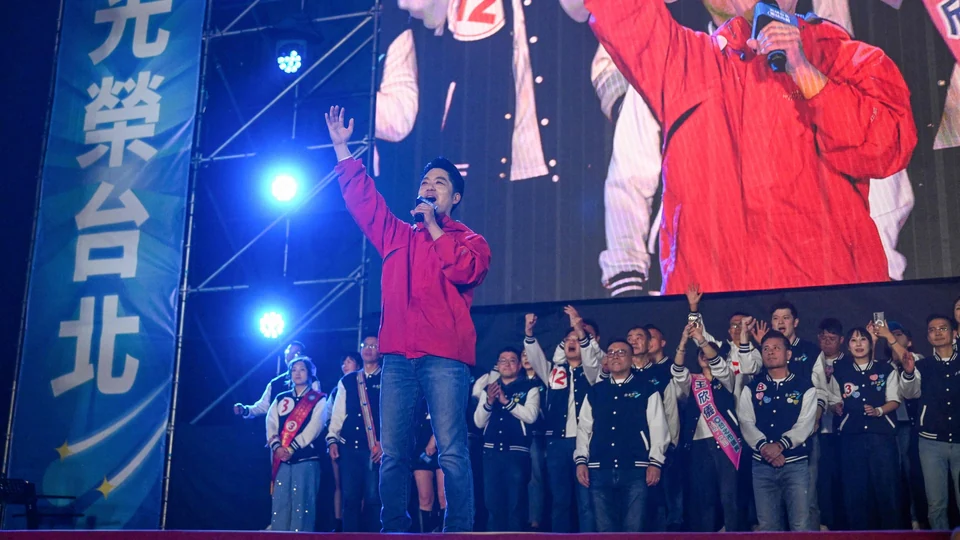
Some 19.6 million people are eligible to vote for mayors and county chiefs across 22 cities and counties, with more than 11,000 smaller roles up for grabs. Polls run from 8 a.m. to 4 p.m., with initial results expected in the evening.
The vote will test whether President Lai Ching-te’s Democratic Progressive Party can translate its record run of three straight presidential victories into gains at the local level, where the opposition Kuomintang has long been stronger. For the KMT, which advocates friendlier ties with China, the results could reorder the field of politicians vying to challenge Lai in 2028 — a contest Beijing is closely watching.
“A poor showing by the KMT would certainly affect Beijing’s calculations going forward,” said Yen Wei-ting, an assistant research fellow at Academia Sinica in Taipei. “It would likely push the KMT to moderate its approach in parliament and move closer to the political center.”
Also Read | Five facts and questions about Taiwan's local elections
Both parties are battling for independent voters. People who don’t identify with or consistently support a particular party account for 30% to 40% of the electorate. They represent the largest and fastest-growing bloc, according to Lev Nachman, an associate professor at National Taiwan University who has researched the island’s political viewpoints for the past decade.
“This election is about whether any party could break through the intense political polarization in the past elections and broaden its appeal among independent voters,” said Austin Wang, an associate professor of political science at the University of Nevada, Las Vegas.
The positions up for grabs are all in local government, and Wang said that most voters will focus on issues like traffic, food safety, childcare and the cost of living, noting that relations with China played a relatively muted role in 2018 and 2022 local elections.
In contrast, the quadrennial presidential and legislative elections, next expected in January 2028, typically see more discussion of foreign policy. The ruling DPP advocates self-determination for the democracy and has been ostracized by Beijing, which claims Taiwan is its territory despite the island never having been part of the People’s Republic of China.
That tension is why foreign investors will watch Saturday’s results for clues on the coming presidential contest and the broader trajectory for ties with China. Taiwan’s tech-heavy equity market is already under pressure amid doubts over the durability of the global artificial intelligence trade, which is powered by chips made on the island. Overseas funds offloaded about NT$1 trillion ($30.4 billion) of local shares on a net basis in November — putting the market on course for a record monthly outflow, according to data compiled by Bloomberg.
“All eyes will be on the mayor elections in the six special municipalities, including Taipei, New Taipei, Taoyuan, Taichung, Tainan and Kaohsiung, as the results tend to provide a good indicator for the next presidential election about a year away,” UBS Group AG’s sales desk wrote in a note to clients. “KMT government is historically perceived to carry lower cross-strait risks, translating into a reduced geopolitical discount potentially, and vice versa.”
Also Read | Taiwan spends billions on sea and aerial drones to deter China; defence push draws global firms
The broad economy is performing strongly, though many people feel they’re missing out on the benefits of the AI boom. The statistics bureau on Friday raised its estimate for full-year economic growth to more than 13%, and forecast a 6.5% expansion in 2027, thanks to demand for tech.
It’s not permitted to publish opinion polls in the 10 days before the vote, but the contest attracting the most interest is the capital Taipei, where the DPP hopes to win the mayoralty for the first time since 1994. Puma Shen is challenging KMT Mayor Chiang Wan-an in what is seen as a contest between potential future presidential candidates. Four of Taiwan’s five directly elected presidents were previously mayors, with three having led Taipei.
A China hawk sanctioned by Beijing, Shen faced an alleged cyberattack targeting his campaign. Wanted by Chinese police for alleged “separatism,” the legislator said he wears a bulletproof vest when traveling overseas. He has also campaigned in a vehicle with bulletproof shields.
Chiang studied and practiced law in the US and is claimed to be a great-grandson of Chiang Kai-shek, who lost the Chinese civil war to Mao Zedong’s communists and fled to Taiwan with the remnants of the Republic of China government. He has visited China and met officials there.
In 2022, the KMT won 14 of Taiwan’s 22 cities and counties, compared with five for the DPP, thanks to grassroots networks going back decades. But the DPP is also trying to flip neighboring New Taipei, Taiwan’s most populous municipality, after losing there by almost 25 percentage points in 2022. It is defending Kaohsiung, a longtime DPP stronghold.
Voters will separately cast ballots in a nationwide referendum on whether the government should revive nuclear power, though the government is already exploring plans to restart shuttered atomic plants.
Taiwanese elections are the biggest democratic exercise in the Chinese-speaking world and the Stockholm-based Global State of Democracy Initiative, which tracks elections globally, says Taiwan is one of the highest-performing societies in terms of democratic rights, representation, participation and the rule of law.
Still, the government has warned of attempts by China to interfere in the elections, including through AI-generated deepfakes, disinformation campaigns, illicit funding and cyberattacks. China has typically stepped up pressure during elections.
To ensure transparency and minimize fraud, votes must be cast in person in the area where a person’s household is registered, while ballots are counted publicly. A desire to participate is why Wang, a 35-year-old finance worker living in Singapore, recently traveled to Taipei to vote for the DPP’s Shen — her first time voting in a local election.
“This is exciting,” Wang said, declining to give her full name while discussing politics. “It’s the first time we might see change.”











