
Carefree, Ariz.
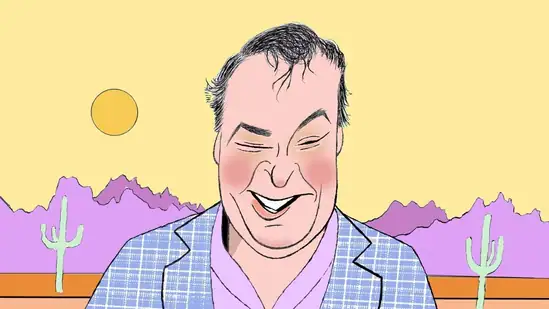
Many Americans take their freedom for granted. Graham Linehan, an Irishman, doesn’t. “Being in America is like escaping a prison,” he says in a tone of relief and redemption. “I felt so hunted in the U.K.”
Suggested For You
This isn’t hyperbole. Mr. Linehan, who moved from Dublin to London in 1990, was arrested by armed police at Heathrow Airport last year for a tweet that was protected here by the First Amendment. In the U.K. it was deemed on its
Carefree, Ariz.
Many Americans take their freedom for granted. Graham Linehan, an Irishman, doesn’t. “Being in America is like escaping a prison,” he says in a tone of relief and redemption. “I felt so hunted in the U.K.”
Suggested For You
This isn’t hyperbole. Mr. Linehan, who moved from Dublin to London in 1990, was arrested by armed police at Heathrow Airport last year for a tweet that was protected here by the First Amendment. In the U.K. it was deemed on its face to incite violence against transgender people.
Until he became an activist, Mr. Linehan, 58, was best known as a comedy writer. He was a co-creator of the sitcom “Father Ted” (1995-98), which gained a global cult following. He boasts five Bafta awards, the British equivalent of the Oscars, and an International Emmy for another sitcom, “The IT Crowd” (2008-10). But now he is a self-described “political exile and free-speech refugee” from Britain, where identity politics has produced startling restrictions on freedom of expression. People have been detained for straying from progressive orthodoxy about race and religion as well as transgenderism.
Mr. Linehan bristles at the common characterization of him as an “anti-transgender activist.” He used to change that to “women’s-rights activist” on his Wikipedia page. “They get changed back within minutes,” he says. “I gave up on that years ago.” He insists that “it’s not semantics,” but about “an underlying philosophy that affirms a belief in a position and doesn’t just rest on opposition to something.” It’s akin to the way advocates in the abortion debate prefer to be described as “pro-life” and “pro-choice.”
Mr. Linehan says his chief concern is “safeguarding biological women and women’s-only spaces, where the presence of males puts women at risk.” He is also appalled by the denial of biological reality and its attendant linguistic contortions. He cites a 2021 TV interview in which Keir Starmer was asked: “Is it transphobic to say, ‘Only women have a cervix’?” The future prime minister replied: “It is something that shouldn’t be said. It is not right.”
Mr. Linehan has questions of his own: “What does ‘trans’ mean?” he says. “I just do not understand the word. I cannot get anyone to explain to me what it actually means. Does it mean transsexual? Does it mean transvestite? And every time I ask, I get this annoyed look, as if I’m an idiot for bringing up the question. I certainly have not heard the same definition twice.”
He used to think it meant transsexual. In his 2023 memoir, “Tough Crowd,” he writes: “There is a clear difference between those who had suffered enough dysphoria that it sent them to the operating table and those who are cross-dressing men.” Mr. Linehan “sympathizes enormously” with the former. His “heart goes out,” he says, “to anyone who suffers from so debilitating a condition that they take drastic steps—often life-shortening, always irreversible—by means of surgery and pharmaceuticals, to bring reality into line with a vision of themselves they can’t shake off.” He has no such sympathy for “a certain group of men who, through sheer self-declaration, we are now going to consider women.”
We’re sitting at the dining table of the rental house northeast of Phoenix where Mr. Linehan now lives. Large saguaro cacti loom outside the window. The town’s name, Carefree, is fitting. Mr. Linehan was being treated for severe depression when he sought refuge here in the spring of 2025. “A friend said to me the other day, ‘Look, Graham, your hands don’t shake anymore.’ ”
His life began to unravel in 2018, when he received a verbal warning from the police for his alleged “harassment” of a trans activist, with whom he’d clashed repeatedly on Twitter. Among his alleged offenses were referring to his antagonist as “he” and “Steven.” (The complainant was born Anthony, changed his name to Steven and subsequently became Stephanie.) Mr. Linehan says the media “sensationalized” the incident, which amounted to no more than a phone call from “a copper who said, ‘Stay away from her, awright?’ ” and then hung up.
Two years later, Twitter suspended his account, claiming he had violated its “rules against hateful conduct and platform manipulation.” Elon Musk restored Mr. Linehan’s account, and those of other critics of transgenderism, in December 2022.
One critic who wasn’t banned was J.K. Rowling, author of the “Harry Potter” books. “She’s too big to ban,” Mr. Linehan says. “She’s also polite, very polite,” though the same can’t be said of her critics, who treat her “like a war criminal.”
He admires Ms. Rowling, whom he calls a “beacon,” but is disappointed that she didn’t express solidarity with him when he was banned from Twitter and treated like a pariah: “She never mentioned me at the time, never said anything in my defense. That’s another reason why I felt I had to get out of the U.K.” The absence of public support from his most prominent putative ally “created the impression that I’d done something wrong.”
He says Ms. Rowling’s case illustrates how “trans activists engage in a very bespoke form of harassment.” If you’re “a billionaire like Rowling, they lobby to take your name off libraries. But if there’s someone like me, they make sure that you never work again.” All his professional contracts were canceled, including a planned musical version of “Father Ted,” which was “going to pay for my retirement.” Old friends and colleagues “stopped speaking to me after the Twitter ban.”
That wasn’t the worst of it. His marriage of 16 years fell apart after his wife was repeatedly threatened and abused and they were doxxed. She pleaded with him to keep his thoughts on women’s rights to himself. Cordelia-like, he says he “simply could not be untrue” to himself. He moved out of the family home, and the couple later divorced. Shunned by the showbiz world and running out of money, he moved to the U.S. after he was encouraged to do so by the comedian Rob Schneider. In the midst of all this, he battled and survived testicular cancer.
Yet fresh hell awaited. On Sept. 1, 2025, he flew to London from his home in Arizona. That’s when he was arrested at Heathrow by a posse of gun-toting policemen and charged with “inciting violence” in three tweets. The one that formed the gravamen—which Mr. Linehan says was satirical—read as follows: “If a trans-identified male is in a female-only space, he is committing a violent, abusive act. Make a scene, call the cops and if all else fails, punch him in the balls.” Now Ms. Rowling rose to his defense, tweeting: “What the f— has the U.K. become? This is totalitarianism. Utterly deplorable.”
Mr. Linehan had flown back for a court appearance to answer charges of harassment and criminal damage brought by a transgender activist with whom he’d scuffled outside an event in London, in the course of which the complainant’s cellphone was allegedly damaged. That case was later dismissed, as were the charges for which he was arrested at Heathrow. In May the London Metropolitan Police apologized for the arrest and paid him £25,000 as compensation.
The disgraceful fact of Mr. Linehan’s arrest—at the behest of a single extremist—remains “as a stain on Britain,” he says. The journalist Toby Young, founder of Britain’s nonpartisan Free Speech Union, concurs: “Graham Linehan has risked everything to stand up for sex-based women’s rights—his family, his livelihood and his freedom,” Mr. Young writes in an email. He notes that the Free Speech Union defended Mr. Linehan: “We assembled a good legal team when he was arrested at Heathrow and managed to get the charges dismissed.” The same team “helped Graham sue for wrongful arrest. I think the police now know that if they go after Graham at the behest of some blue-haired activist it won’t end well for them.”
Mr. Linehan isn’t so sure. Unlike the U.S., where opinions about transgenderism tend to divide along political lines, in the U.K., “trans orthodoxy now has a bureaucratic niche. The activists have got their feet under the table in institutions all across England, Scotland and Wales.” Their views have “crossed over into various places that you wouldn’t expect them to be, like the police force.” Even MI5, Britain’s domestic intelligence agency, has “had a trans flag hanging outside their headquarters.” (That did happen, in 2021, but isn’t institutional policy.) He also cites schools, universities and hospitals as “institutions that have succumbed to trans-activist ideology”—something that has also happened here.
Why does Mr. Linehan care enough to die on this hill? He says he met a man in a pub in 2017 who told him his teenage daughter “had convinced herself she was trans and was disappearing before his eyes.” The father said adults were exhorting the girl to take testosterone and her “health was crashing.” Mr. Linehan said to himself, “I have to get involved.”
“When people ask me why I care so much, I reply, ‘Why aren’t you standing up for kids who are being told to cut their breasts off because crazy adults have told them that they’re really boys?’ I do not understand why every thinking person who believes in fairness and truth is not on this hill fighting with me, or in this ditch dying with me.”
Many of the people who ask him this question, he says, “are trying to shame me into silence,” suggesting that he is “hysterical and unreasonable” and doesn’t know where to draw the line. In his memoir, he writes: “The implication is that a concern for women’s rights (normal, explicable) is actually an obsession with trans rights (bigoted, deranged). But trans rights only become an issue when they negatively affect women’s rights.”
“When people ask me, ‘Why do you care?’ I say, ‘Why do you not?’ ” If we didn’t care, it would be “entirely acceptable to do what Lancet did.” He refers to a September 2021 cover of the once-venerable medical journal that referred to women as “bodies with vaginas.” The editor in chief was compelled to apologize for this dehumanizing language. Mr. Linehan asks: “Do you think he would have done so if people hadn’t shamed the Lancet?”
Mr. Linehan has “no intention to ever live again in the U.K.,” he says. “It’s not possible to live anywhere that doesn’t protect freedom of speech the way the U.S. does—with the fact that it’s actually in the Constitution.” He is applying for a green card and has just finished writing eight episodes of a sitcom called “Tenure,” set in a fictional “Harvard of the desert.” The protagonist is a professor who collides repeatedly with the thought police. “I’ve cannibalized some of my own experiences.”
On visits to the U.K. he often meets with hostility on the streets, “nasty things like ‘How’s the divorce, Graham?’ ” In the U.S., he feels “anonymous and free.” He wants to “try and make America happy that they’ve embraced me. I keep having this uncanny feeling that I’ve died, and that this is some sort of weird afterlife where they just don’t tell you it’s the afterlife. It’s like being in a strange sort of heaven.”
Mr. Varadarajan, a Journal contributor, is a fellow at the American Enterprise Institute and at NYU Law School’s Classical Liberal Institute.
One Subscription.
Get 360° coverage—from daily headlines
to 100 year archives.
Archives
HT App & Website
