There is something about starting the day with a glass of freshly made carrot-beetroot juice or orange juice that sounds like a good idea, especially when you are trying to cut down on packaged drinks. But making juice at home every morning also means washing fruits, chopping ingredients, operating a machine and, of course, cleaning it afterwards. That last part is something you might not think about when buying a juicer!
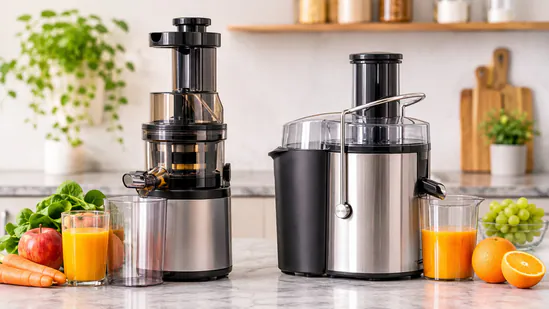
This is where choosing the right appliance matters. Cold press juicers promise slower extraction and less frothy juice, while centrifugal models are designed to get the job done faster. But is it worth spending more on a cold press juicer if all you want is a quick glass of fresh juice before breakfast? Let's compare the two to find out which one fits different kitchen routines and everyday needs.
Cold press vs centrifugal juicers: What is the difference?
The biggest difference between cold press and centrifugal juicers is how they extract juice from fruits and vegetables. A cold press juicer crushes and squeezes produce slowly, while a centrifugal juicer uses fast-spinning blades to separate the juice from the pulp.
Cold press juicers, also called slow juicers or masticating juicers, use an auger to crush ingredients against a filter. This process generally produces less froth and introduces less air into the juice.
Centrifugal juicers work at much higher speeds. Their rotating blades shred fruits and vegetables before centrifugal force separates the juice from the pulp. They are generally quicker, making them convenient when you want a glass of juice without spending too much time on preparation.
Here is a quick comparison:
| Feature | Cold press juicer | Centrifugal juicer |
| Working mechanism | Crushes and squeezes produce using an auger | Uses fast-spinning blades |
| Extraction speed | Slower | Faster |
| Juice texture | Generally smoother with less froth | Can be more frothy |
| Oxidation | Generally introduces less air | Can introduce more air |
| Noise | Usually quieter | Usually noisier |
| Cleaning | Can involve more components | Often relatively straightforward |
| Price | Generally more expensive | Generally more affordable |
Best cold press juicers
Cold press vs centrifugal juicers: 6 key differences explained
1. Juice quality and nutrient retention
Cold press juicers crush and squeeze fruits slowly, generally producing smoother, less frothy juice with less air incorporation. Centrifugal juicers use high-speed blades, which can introduce more air and cause quicker juice separation.
2. Juicing speed and everyday convenience
Centrifugal juicers extract juice faster, making them convenient when you want a quick glass before breakfast or work. Cold press models take longer because they crush ingredients gradually, making them better suited to relaxed juice preparation routines.
3. Fruits and vegetables you can juice
Cold press juicers generally handle leafy greens such as spinach, celery and coriander more effectively. Centrifugal models work well with common produce such as apples, carrots and beetroot, making them suitable for everyday fruit and vegetable juices.
4. Noise levels during operation
Centrifugal juicers use fast-spinning blades and tend to produce more noise during operation. Cold press models generally run more quietly, which can be useful if you prepare juice early in the morning while other family members are asleep.
5. Cleaning and maintenance
Cold press juicers often have multiple detachable components, including augers and filters, which require thorough cleaning. Centrifugal models can be relatively easier to maintain, although their mesh filters also need proper cleaning to remove trapped pulp and fibres.
6. Price and long-term value
Centrifugal juicers are generally more affordable, making them suitable for first-time buyers and occasional use. Cold press models usually cost more, but may justify the investment if you regularly prepare leafy green juices and prefer their extraction style.
Best centrifugal juicers
Cold press vs centrifugal juicers: Pros and cons
Still confused? Here is a quick look at what each type brings to your kitchen.
Cold press juicer: Pros and cons
| Cold press juicer | |
|---|---|
| Pros | Cons |
| Generally produces less frothy juice | Slower extraction process |
| Works well with leafy greens | Generally more expensive |
| Usually quieter during operation | Cleaning can take longer |
| Introduces less air during extraction | Can require more preparation |
Centrifugal juicer: Pros and cons
| Centrifugal juicers | |
|---|---|
| Pros | Cons |
| Faster juice extraction | Usually noisier |
| Generally more affordable | Juice can be more frothy |
| Convenient for quick morning preparations | May be less effective with leafy greens |
| Suitable for many common fruits and vegetables | Juice may separate more quickly |
Which juicer should you buy for daily use?
The right choice depends on what your everyday routine looks like. There is little point in buying an expensive slow juicer if you are usually rushing through breakfast. Similarly, a basic centrifugal model may not satisfy you if you enjoy experimenting with different vegetable and leafy green combinations.
Here is how I would approach the decision:
| Your daily requirement | Recommended juicer |
| Quick glass of juice before work | Centrifugal juicer |
| Regular spinach, celery and green juices | Cold press juicer |
| Preparing juice on a limited budget | Centrifugal juicer |
| Less frothy juice | Cold press juicer |
| Quieter morning operation | Cold press juicer |
| Frequent juicing of common fruits | Centrifugal juicer |
| Preparing different fruit and vegetable combinations | Depends on the ingredients |
Choose a cold press juicer if: You regularly prepare vegetable juices, enjoy leafy green combinations and prefer less frothy juice. It is also worth considering if you do not mind spending extra time on extraction and cleaning.
Choose a centrifugal juicer if: You want something affordable, quick and convenient for everyday fruit juices. It is a sensible option if you have a busy morning routine and do not want juice preparation to become another time-consuming kitchen task.
What should you look for when buying a juicer?
Beyond choosing between cold press and centrifugal technology, pay attention to a few practical features before making a purchase.
Motor performance: Do not judge a juicer only by its wattage. Look at the motor design, recommended usage and ability to handle the ingredients you plan to juice.
Feeding chute size: A wider feeding chute can reduce chopping and preparation time, particularly when using whole apples or larger vegetables.
Juice and pulp container capacity: If you prepare juice for two or more people, check the container capacity to avoid frequent emptying.
Cleaning convenience: Removable components, accessible filters and included cleaning brushes can make everyday maintenance easier.
Safety features: Look for locking mechanisms, overload protection and a stable base to prevent unwanted movement during operation.
Warranty and service: Check the motor warranty, availability of replacement filters and access to authorised service centres.
- Is a cold press juicer better than a centrifugal juicer?
Cold press juicers generally produce less frothy juice and handle leafy greens well, while centrifugal models are faster and more affordable.
- Which juicer is better for daily use?
A centrifugal juicer suits quick everyday fruit juices, while a cold press model is preferable for regular vegetable and leafy green juice preparation.
- Can centrifugal juicers extract juice from carrots and beetroot?
Yes. Most centrifugal juicers can process hard produce such as carrots and beetroot, provided the manufacturer's instructions permit their use.
- Can you make green juice in a centrifugal juicer?
Yes, but centrifugal models may extract less juice from leafy greens compared with cold press juicers designed for fibrous ingredients.
Similar stories for you
Disclaimer: At Hindustan Times, we help you stay up-to-date with the latest trends and products. Hindustan Times has an affiliate partnership, so we may get a part of the revenue when you make a purchase. We shall not be liable for any claim under applicable laws, including but not limited to the Consumer Protection Act, 2019, with respect to the products. The products listed in this article are in no particular order of priority.
