
Stand back, everyone. This is the word-nerd’s favourite time of the year. It’s when every dictionary of note (all four of them) releases the Word Of The Year with as much fanfare as academia allows.
On the Oxford University Press’s shortlist: Post-literate. Slopaganda. Doomerism. Microdrama. Presumably because the lexicographers had their heads in their phones for much of 2026. Some dictionaries have already released their Word Of The Year. Cambridge picked Human; at Collins, it’s Mogging; Dictionary.com selected Maxxing.
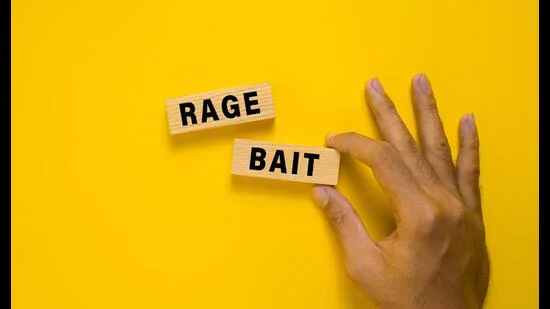
As the defining terms of the whole year, they’re relatively tame. Remember when Dictionary.com named 6-7 as the “Word” Of The Year in 2025? Or when Oxford University’s WOTY, Rage Bait, pretty much rage baited us all last year? Slang is changing and spreading faster than ever. Some of it is dying out the moment it gets popular (See: Cheugy, which means uncool, and became uncool the second it went mainstream in 2024). So, how do language researchers track language and pick the Word Of The Year, anyway? We looked it up.
One book to rule them all
{{/usCountry}}One book to rule them all
{{/usCountry}}The reason there are so many English-language dictionaries is because “there’s no single governing academy or authority that decides what every word should mean or how it should be used in the English language,” says Abhishek Avtans, linguist and lecturer at Leiden University, Netherlands. In contrast, the Académie Française for French, the Nederlandse Taalunie for Dutch, and the Council for German Orthography for German, are authorities on those languages.
The Oxford English Dictionary has the most words (more than 5.2lakh, many absorbed from other languages). But the Cambridge Dictionary, the American Merriam-Webster, Dictionary.com and Urban Dictionary, all compete to find new words and new usage, and show how English is evolving in different regions, among different groups. Researchers presumably spend the other 364 days of the year deciding whether “larping” or “lowkenuinely” should be real words. British dictionaries tend to have a more scholarly bent, while American ones are more practical, says Avtans.
Board-game geeks already knew of the official Scrabble dictionary (which recognises skibidi and unc as legit words). Now, there’s a list of Wordle terms too (Pshaw? Really!). In 1992, Hungarian author Thomas Kabdebo even attempted to put together a Dictionary of Dictionaries, collating 6,000 of them, including specialised glossaries on subjects such as ceramics, book-binding and Americanisms. Cute. But outdated.
Rules? Laws? Hold my beer…
New additions to a dictionary reveal not just how we communicate, but what experts will allow. This year alone, Merriam-Webster added about 1,400 new words, including Sunday scaries, crashout and cuffing season (or actively searching for a partner during the winter months). “Several of these terms feel as if they originated purely on the internet, when in reality, they’ve been around for much longer,” says author Sumanto Chattopadhyay, who breaks down word meanings and origins on his Instagram page, @TheEnglishNut. “Every generation has its own slang, and these words emerge because we need to describe what is happening to us.”
The internet has sped up the rate at which new terms become popular, making lexicographers’ jobs harder. Samuel Johnson spent eight years listing 42,773 words for his A Dictionary of the English Language, which came out in 1755. A revision didn’t come out until 1773. Now, words get added all through the year, lest rival dictionaries get there first.
And language itself now so chill, your English teacher might faint. English has gone from being prescriptive (how words ‘should’ be spelled, pronounced and used) to being descriptive: “Rather than judging whether a word is right or wrong, we look at how people use it, who uses it, in what situations and with what meaning,” says Avtans. So, prepone, once reviled, is now an accepted antonym of postpone.
Look out! New words coming through
What wins Word Of The Year depends on who’s doing the selecting and what’s in their echo-chamber. Oxford University Press’s four shortlisted words were chosen after analysing a “32-billion-word corpus of language data” and “reflect the ideas, concerns and cultural shifts that have shaped 2026”, according to their Instagram post. Cambridge Dictionary’s 2026 WOTY: Human, isn’t a new word, but a meaningful one in a year when everyone was preoccupied with AI. Collins’s 2026 WOTY: Mogging beat out friendslop, ghost job, and fricy. The term means outshining someone and making them look inferior – an acknowledgement of incel dating culture.
The internet found the Oxford University Press shortlist (post-literate, slopaganda, doomerism and microdrama, if you’ve forgotten) depressing. “It’d be cool if one time the word of the year wasn’t about the downfall of society,” commented @KatAtlanta21 on their Insta post. Chattopadhyay says that highlighted terms “will always capture our preoccupations,” because they reflect both collective worries and specific obsessions. They also record life’s micro-moments. Consider Bixie, a haircut that is shorter than a bob but longer than a pixie; air jail, or suspending your catto or doggo above the ground when they’re behaving badly.
The final word
In India, Shabdkosh, running since 2003, lists definitions, pronunciations, and example sentences for Hindi, Bengali, Gujarati, Kannada, Malayalam, Marathi, Punjabi, Tamil and Telugu. The government’s AI-assisted translation platform, Bhashini works with 22 Indian languages; and Anuvadini AI is useful for academic terms and works across scripts too. Open-source dictionaries, such as V Krishna’s Alar for Kannada-English is available online, as is the Malayalam dictionary Olam.
Because they’re prescriptive, they expand less often, says Avtans. To see how real people actually use everyday language, look up Wiktionary’s colourful Hindi slang page. Think tapori, dhinchak, and siyappa (of course the best phrases are unprintable!).
Or forget usage and just let the new words roll around in your mouth. The Bermudian word bimpert and the Welsh word twpsyn both refer to foolish persons. Last year, OED included the East African word mitumba, which refers to second-hand clothes that are dumped by Western nations into developing countries. “It’s lovely when new terms like this enter the lexicon,” says Chattopadhyay. “It describes what we’ve been thinking and doing and feeling for a long time, but didn’t have the vocabulary for.”
From HT Brunch, November 28, 2026
Follow us on www.instagram.com/htbrunch
