
 E-Paper




Drawing Room: Avijit Mukherjee on GR Iranna’s richly layered art




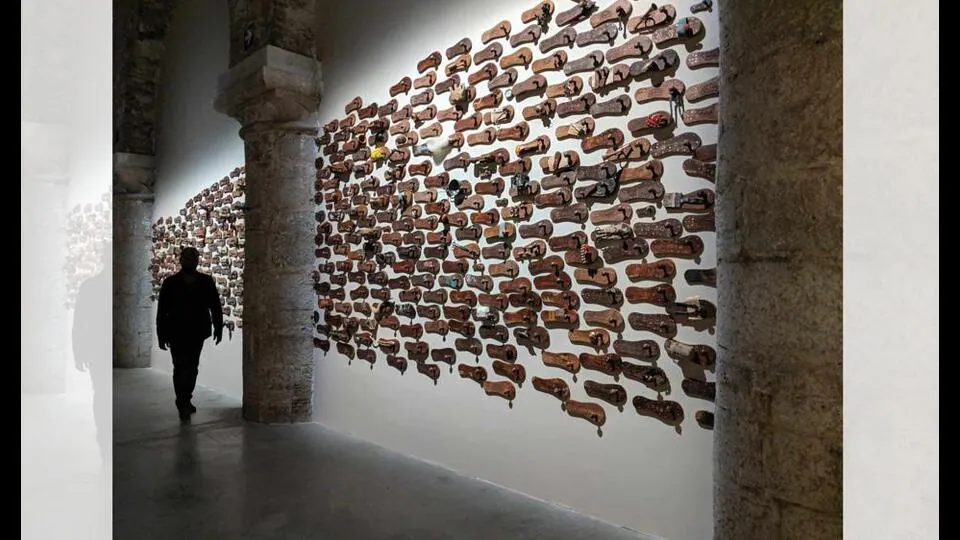
GR Iranna uses wooden sandals, ash, even begging bowls to tell a story. There are painful flashbacks, some history, but scenes of triumph and renewal too
If you’re planning to view the works of Iranna Rukumpur, or GR Iranna as he is better known, make time. Not just because the works themselves are very detailed, but because they also carry so many backstories and references. And prepare to do some furious googling.
Take his seminal work, Naavu, which was displayed at the Venice Biennale in 2019. The massive installation consisted of hundreds of wooden sandals or padukas, traditionally worn by saints and monks, displayed on a wall. It was a nod to Mahatma Gandhi in the 150th year of his birth. It doesn’t take much to make one connection: The sandals and the Mahatma (who famously walked long distances) leading millions of Indians on the Dandi March in 1930, defying British rule with every step, and ultimately showing the power of non-violent resistance.
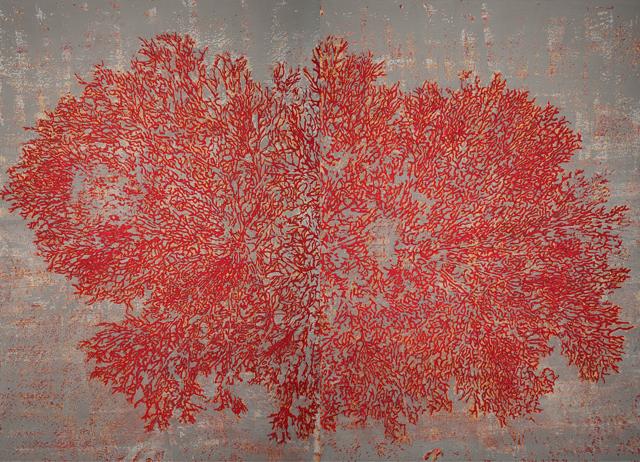
Yet, the work started out as something entirely different. When Iranna began it in 2010, he had recently visited Jallianwala Bagh in Amritsar, the site of the 1919 massacre, in which the British opened fire on peaceful protestors, blocking the only exit. Iranna imagined the scores of people attempting to scale the walls to escape the flurry of bullets. He originally titled the work Panic Garden, trying to replicate the misery and fear he felt as a visitor to the site. It’s only later that he reimagined the installation as an emblem of peace with Gandhi’s message at the forefront. Naavu is subtitled We All Together, translated from Kannada, which seems fitting, and more optimistic.
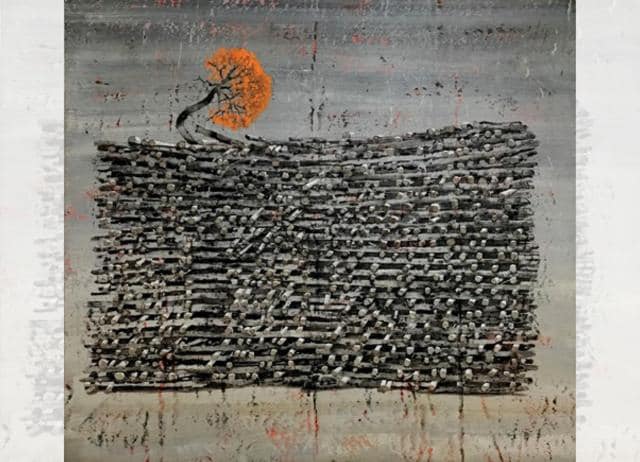
Another work, acrylic on tarpaulin, is titled Light in Hidden Ash (2017), and needs a bit of a preamble too. At first glance, there’s a lone orange flower emerging from a deep black-and-white structure, perhaps an arrangement of wooden sticks, perhaps a wall, a barrier. It’s at odds with the vibrant bloom. This isn’t simply about life emerging from rubble. Iranna has long used ash as a medium, to draw attention to its purity, it’s place in Hindu ritual, and the idea of renewal. He even named his 2021 show Boodi, the Kannada word for ash.
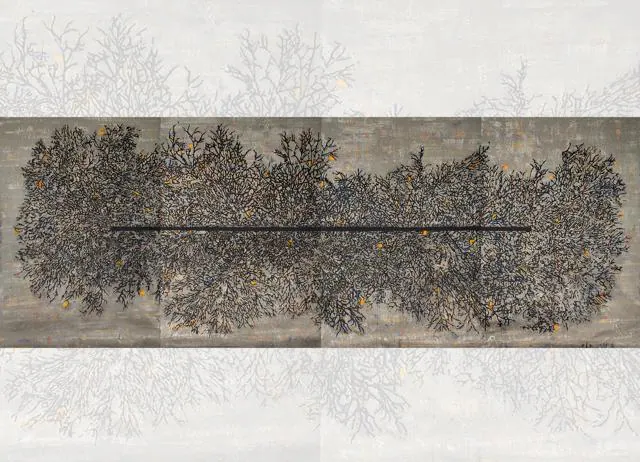
Iranna was born on a farm in Sindgi, Karnataka in 1970. He worked in the fields alongside his family, and studied in the local Gurukul Sarang Math, where his Guru recognised his talent and encouraged him to pursue art. His first canvases were the neighbourhood roads, his first medium was chalk, his first subjects were the gods, specifically Hanuman. Iranna is inspired by the simplicity of life he witnessed in his early years, but he is also interested in the many cycles of renewal civilisation has been through. At his ongoing solo show at the Bihar Museum in Patna, he references the many histories of Bihar, which has been razed to the ground and rebuilt by dynasties over centuries. At the same show is a work titled The Vessels of Absence, in which large towers, made by black begging bowls belonging to Buddhist monks, become the site of a sound installation where one can hear soothing chants on repeat.
He’s constantly thinking about big ideas and the little things. To fuse both into the same work takes skill and care – to identify both as a viewer takes effort. It’s worth it.
ARTIST BIO: Avijit Mukherjee is a self-taught artist based in West Bengal whose layered paintings are where pop art meets surrealism.
From HT Brunch, November 28, 2026
Follow us on www.instagram.com/htbrunch











