
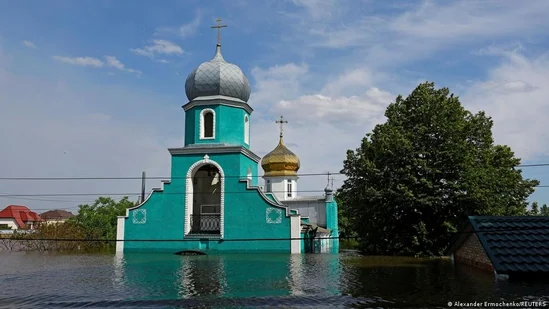
Tens of thousands of people are directly affected by the floods following the breach of the Kakhovka dam in southern Ukraine. Leaking oil threatens to cause serious damage to nature and animals as well. And, once again, cultural heritage sites and with them Ukraine's history are also at risk from the destruction, which many observers describe as a war crime.
Churches, monuments and museums are submerged all over the Kherson region. Archaeological sites dating back to the Scythians — a nomadic people who lived in the region in the 8th century BC — and a Greek settlement from around 400 BC have been damaged or irretrievably destroyed. (Also Read | Louvre museum exhibits icons from Ukraine)
"The damage affects culturally and historically significant properties from different centuries," Kilian Heck, an art historian at the University of Greifswald, told DW. "In terms of archaeological sites, Ukraine is one of the first places of discovery in the world." The affected region in southern Ukraine had also become the center of Cossack culture in the 16th century and was also symbolically significant for the country's independence.
Extent of the destruction not yet foreseeable
The extent of the damage is not yet clear, and information is scarce. Large parts of the flooded region are occupied by Russian troops, the Dnipro river marks the front line between Russian and Ukrainian soldiers.
{{/usCountry}}The extent of the damage is not yet clear, and information is scarce. Large parts of the flooded region are occupied by Russian troops, the Dnipro river marks the front line between Russian and Ukrainian soldiers.
{{/usCountry}}According to official Ukrainian information, a museum honouring writer and humourist Ostap Vyshnya, which was not restored until 2020, and the Kherson Art Museum, named after painter Oleksii Shovkunenko, remain flooded as well.
In the flooded town of Oleshky, the former residence of folk artist Polina Rayko had been damaged by the water as well. The artist had begun painting only at the age of 69. She painted frescoes on the walls of her house and the building is one of Ukraine's official cultural heritage sites.
"The situation is unprecedented," says Kilian Heck, who helped initiate the Ukraine Art Aid Center after the Russian invasion last year. The network of art historians and museum experts organizes aid shipments with packaging materials, generators or dehumidification equipment to protect works of art in Ukraine from the consequences of the war.
A certain routine was established during the war. Kilian Heck explains: "We rehearsed routines like: pack the works up, put them in the basement or evacuate them."
The flood, on the other hand, is a completely new challenge: "There are hardly any means of responding appropriately in terms of conservation. It's a new form destruction of cultural assets."
In frequent Zoom meetings, German art historians exchange information with colleagues from Ukraine. Colleagues from the flooded areas had recently reported corpses floating in the water, which had been washed out of the cemeteries by the masses of water. Animal carcasses floating in the water, as well as contamination, also raised concerns about epidemics.
"The most important thing right now is to provide water filters," says Kilian Heck.
The dam and hydroelectric plant near Kachowka were destroyed on June 6, with Ukraine and Russia blaming each other. Ukrainian authorities have called on the International Criminal Court in The Hague to investigate the destruction of the dam. The reservoir stored about 18 billion cubic meters of water. Authorities in the Kherson region reported that 600 square kilometers of land had been flooded — about the size of Chicago.
ABOUT THE AUTHOR
Krishna Priya Pallavi is a journalist with over 9 years of experience, covering health, fashion, pop culture, travel, wellness, entertainment, festivals, mental health, art, decor, fitness, and sex and relationships. She is an alumna of the Indian Institute of Mass Communication (IIMC), Dhenkanal, and holds an undergraduate degree in Journalism and Mass Communication from Guru Gobind Singh Indraprastha University, Delhi. Her strong academic foundation informs her analytical and detail-oriented approach to storytelling, helping her uncover stories where none seem to exist. Before joining Hindustan Times, Pallavi worked with some of India’s leading media organisations. She spent close to three years at India Today, where she honed her newsroom skills and developed a sharp editorial sensibility. She also worked for over a year and a half at Vagabomb, ScoopWhoop’s feminist digital platform, where she explored stories through a gender-sensitive, socially aware lens. Pallavi has a deep interest in global fashion trends and international fashion seasons, and enjoys interviewing celebrities and tracking pop culture movements—interests that frequently translate into engaging, reader-friendly stories. Alongside lifestyle and entertainment, she has a keen eye for impactful health and wellness journalism, regularly interacting with doctors, designers, and digital content creators to bring nuance and credibility to her work. Born and raised in Haryana, Pallavi remains deeply connected to her ancestral roots in Odisha. Her ability to spot fresh angles brings curiosity and depth to stories she pursues. When not chasing deadlines, she enjoys spending time with her dog, planning her next vacation, reading, running new trails, and discovering new destinations.
