
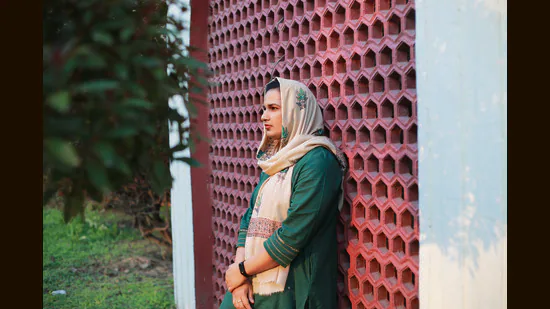
“If I can make the world a less cruel place, I want to do it,” says Dr Aqsa Shaikh.
She knows what cruelty feels like.
As a 23-year-old, she was studying for her MBBS degree at King Edward Memorial (KEM) Hospital in Mumbai in 2006, when she realised she wasn’t gay, she was transgender. So much of what she had felt since she was a child started to make sense.
“I decided to live my life honestly, like the person
“If I can make the world a less cruel place, I want to do it,” says Dr Aqsa Shaikh.
She knows what cruelty feels like.
As a 23-year-old, she was studying for her MBBS degree at King Edward Memorial (KEM) Hospital in Mumbai in 2006, when she realised she wasn’t gay, she was transgender. So much of what she had felt since she was a child started to make sense.
“I decided to live my life honestly, like the person I felt like inside rather than the one I was born as: a man,” she says. But when she told friends she intended to transition, they shunned her.
“Some said they felt betrayed by my decision. Some severed ties with me because Islam doesn’t allow it,” she says. Her mother thought she wanted to “become a hijra”. Dr Shaikh had to show her videos of prominent transgender people, to explain what she meant.
Alone and confused, the young doctor spent years struggling with depression.
“I feel like the medical education system failed me too,” she says. “I faced rejection so severe, I wanted to quit my course. I couldn’t even attend my own convocation.”
At that point, she became determined to claim her space. She has fought for jobs and advocated for herself and others, determined to occupy the space that is her due, and help others do the same.
Now 43, Dr Shaikh is a professor of community medicine at Delhi’s Hamdard Institute of Medical Sciences and Research (HIMSR). She is proud to have been the first transgender person to head a Covid-19 vaccination centre in India, during the pandemic.
She works to challenge outdated curricula that view queerness as a disease; she has petitioned to make non-consensual surgeries on intersex children illegal. She wants medicine to be more inclusive, to people across the sexuality spectrum, as well as to marginalised communities, and to the differently abled.
She is also on a Supreme Court-appointed task force to help frame policy that addresses student mental health struggles and student suicides, particularly at premier institutes. Her advocacy has earned her a spot on Time magazine’s inaugural 100 Next India list. “Success is a big antidote to transphobia. That’s unfair but true,” Dr Shaikh says.
Excerpts from an interview.
* It isn’t an easy mission to choose: trans-inclusive medicine…
Well, once I had surgery, I felt selfish for only caring about my distress.
I transitioned in 2019, just before we were hit by the pandemic. Before that, I didn’t want to be an activist or publicly come out as a trans person. But in the pandemic, I felt the world becoming more hostile and dangerous for vulnerable people. It struck me that if I could help reduce the damage even a little, my life would have meaning.
Today, I would say that is the mission of my life: To address issues that become blind spots, be an ally of the vulnerable, and support causes that do not affect me directly.
* What has it felt like, getting to this point of recognition?
I’ll be honest, because I don’t want to draw up a heroic narrative. As a trans person, I have had a very tough journey. I have battled depression, suicidal ideation and bullying.
People are murdered because they are trans. But a lot of trans people kill themselves. Though I never attempted it, I did go as far as to write out suicide notes.
From then to now, I feel blessed to be recognised for my work. I feel blessed for the opportunities I have got. All the recognition helps carry my voice to a lot more people. I think it prompts conversations, reduces stigma and increases acceptance.
Success is a big antidote to transphobia. Someone once told me that if I was not a doctor or not successful, my family and friends would not have supported me. That’s not entirely untrue, and that’s unfair, especially to children who are coming out.
My work focuses more on trans children and adolescents than trans adults because adults still have some agency to change things, but children have no help.
Today, I know people are using my story to explain their situation to their families. And that’s a good feeling.
* What are some of the most urgent changes we need in the healthcare system?
Conversion therapy is still not illegal in India. People get paid by families to damage young people’s lives. It is only recognised as misconduct if an MBBS practitioner does it. But Unani doctors practise it widely. That is a black spot on our healthcare system.
Meanwhile, since society largely recognises only two genders, doctors manipulate parents’ insecurities to sell surgeries on intersex children. We would rather butcher children, leaving lifelong consequences on their bodies and psyche, than change society.
* There is a sense that Gen Z is shedding some of these prejudices very effectively…
I’m a big fan of Gen Z. They are a lot more sensitive to the struggles of the vulnerable, thanks to social media. New OTT series help normalise the community too, with depictions that are real, not caricatures. All this helps.
* Yet we’re still getting quite a lot of stuff wrong.
When the Delhi Metro introduced toilets for trans people, the symbol was a half man-half woman. That’s not what transgender people are. It was like they got one thing right and another wrong. I wrote to the human rights commission. They helped action the change and the new sign is the letter T.
Another time, I filed RTI petitions, complaining about the lack of transgender toilets in public buildings. The Municipal Corporation of Delhi has since created some. So there is change…
* You mentioned a recent milestone in your personal life…
I have always wanted to go to the gym but found it a very intimidating place. Have you ever seen a trans person in a gym? I thought I would be ostracised, so I never enrolled.
A friend then invited me to enrol in her gym. When I went, people stared, of course. But the instructor has been amazing. I’ve been going for six months now, and also made great gym buddies. Going to work out is now the highlight of my day.
* What would your ideal world look like?
It would be a world that celebrates diversity. So many die by suicide because they are seen and treated as different. The world must realise that different is not inferior.
I wish for an India where no person feels that living is more difficult than dying.
One Subscription.
Get 360° coverage—from daily headlines
to 100 year archives.
Archives
HT App & Website
