
What I love, perhaps most, about animation is that it lets us relate to fast-talking rabbits, diffident mice, aggressive ducks, even plain geometric shapes. Yet, amid the whimsy, it can tell stories as powerful as any great novel.
As we celebrate the 100-year history of the art form, here are my five favourite milestones.
SHADOW DANCERS
In 1914, Lotte Reiniger was a film-mad 15-year-old in what was then the German Empire.
She had been obsessed with movies since she attended a
What I love, perhaps most, about animation is that it lets us relate to fast-talking rabbits, diffident mice, aggressive ducks, even plain geometric shapes. Yet, amid the whimsy, it can tell stories as powerful as any great novel.
As we celebrate the 100-year history of the art form, here are my five favourite milestones.
SHADOW DANCERS
In 1914, Lotte Reiniger was a film-mad 15-year-old in what was then the German Empire.
She had been obsessed with movies since she attended a lecture by Paul Wegener, the pathbreaking director of silent classics such as The Golem (1915). The lecture was about “trick films”, or special effects.
Reiniger was so smitten, she persuaded her parents to send her to Max Reinhardt’s acting school. As she noted later, in a letter to film historian Giannalberto Bendazzi, she “could really do nothing at all well but cut-out silhouettes”.
She used this talent to experiment with silhouette animation, cutting figures into separate pieces, joining their limbs with tiny hinges, and moving them fractionally between shots.
She made her first movie, a five-minute short called The Ornament of the Lovestruck Heart, in 1919. Seven years later, she completed The Adventures of Prince Achmed, a 65-minute feature based on stories from One Thousand and One Nights.
This is considered the birth of the animated film.
…Prince Achmed (1926), available online, remains impressive even a century later. There are graceful dancers, gallant princes, galloping horses, evil sorcerers.
It cast a long shadow too. There is a direct line to be drawn from it to Jordan Mechner’s videogame Prince of Persia (1989), and to the villainous Jafar of Disney’s Aladdin (1992).
Reiniger’s work was a remarkable demonstration of the possibilities of animation.
Her figures danced, flew, fought and transformed themselves against intricately layered backgrounds. There was no attempt to replicate the real world. The frames had more in common, in fact, with the traditional shadow-puppet plays of China, India and Indonesia.
CEL THEORY AND SNOW WHITE
Around this time, Walt Disney and Ub Iwerks in the US were working on something that would transform this art form. It was based on a technique called cel animation, developed by Earl Hurd and John Bray in 1914.
A cel (short for celluloid) was just a transparent sheet.
But an artist could draw characters on it, though, place them against a static background, and start to bring an imaginary scene to life. This allowed for a dramatic reduction in the amount of work, time and effort involved.
Disney and Iwerks used the cel to turn a somewhat niche art form into a large-scale industrial enterprise. Over decades, they refined their techniques until the movement became smoother, the frames busier and more vibrant.
Their crowning achievement would be Snow White and the Seven Dwarfs (1937), Hollywood’s first full-length cel-animated feature in Technicolor.
It combined comedy, horror, music and romance in an irresistible concoction that is still beloved. The phrases “heigh-ho”, “whistle while you work” and “someday my prince will come”, all titles of songs from the film, entered the popular vocabulary.
It cost an estimated $1.5 million to make, making it the most expensive animated feature by far. But it earned about $8 million in just its initial run at the box office.
The music and voice acting stood out. But what truly made it a milestone, and made Disney the world’s preeminent studio for animation, was the quality of the images. Even today, the scenes in which the evil queen brews her poison retain their power to chill.
Disney would set the standard for decades.
High-budget, detailed, ambitious films brought fairytales to life for riveted families: Pinocchio, Bambi, Dumbo, Fantasia. But the studio’s success would establish a set of conventions other animators would eventually want to escape.
REBELS MAKE IT TO TELEVISION
In 1943, former Disney artists desperate to experiment more freely — men such as Zack Schwartz, David Hilberman and Stephen Bosustow — united to form Industrial Film and Poster Service, which became United Productions of America (UPA).
They developed a style called “limited animation” that was a combination of reused frames, recycled figures and symmetrical drawings. This allowed films to be produced cheaply and quickly.
The approach was ideal for a new medium that had small budgets, but a voracious appetite: television.
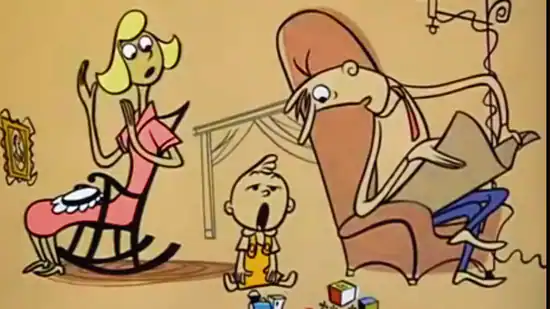
A typical example of UPA’s approach is Gerald McBoing-Boing (1950). Based on a story by Dr Seuss, its central character is a little boy who cannot speak in words and communicates instead through sound effects. The film dispenses with the elaborate backgrounds and naturalistic character design associated with Disney. Often, there are no backgrounds at all.
Characters move against solid swatches of colour. A staircase is just a jagged line. A door stands in the middle of nowhere. Perspective is distorted.
In a sense, UPA returned animation to the possibilities Reiniger explored with her silhouettes: the freedom to create a world that obeyed the logic of the artist rather than of reality.
ASTRO BOY AND ANIME IN JAPAN
In the West, William Hanna and Joseph Barbera used limited animation to great effect, creating characters such as Huckleberry Hound, Yogi Bear and Quick Draw McGraw, who became staples of Saturday morning television, beloved to generations of children (and adults).
In Japan, meanwhile, Osamu Tezuka used TV’s limitations to create a distinctive style.
His limited animation turned the camera into its own character, panning and zooming at odd angles to create the impression of explosive action. His characters, with their large expressive eyes rooted in his manga, burst to life on the small screen.
Tezuka’s Astro Boy (1963), the first animated half-hour Japanese TV series, was a phenomenal success and helped establish the foundations of the anime industry.
.
IN THE US, BATMAN GOES DARK
Dark Deco would be the next turning point.
Batman: The Animated Series arrived in 1992. On the face of it, it was one more children’s superhero cartoon. But it was so much more.
Developed by Bruce Timm and Eric Radomski for Warner Bros Animation, it had a striking new visual identity. The backgrounds were painted on black paper rather than white, in a technique called Dark Deco.
Its Gotham City was an Art Deco metropolis of towering structures, dark streets and menacing pools of light. It was film noir, woven into the world of superhero cartoons.
The series still makes it to lists of the greatest TV shows of all time.
.
MORE REBELLION, SOME TOYS, AND A NEW ERA IS DRAWN
And then came Pixar.
Once again, it was an exhausted Disney animator who set the ball rolling.
John Lasseter thought the time was ripe for a new kind of art form. In 1983, he pushed for a computer-animated version of the Disney short, The Brave Little Toaster. He was fired for his pains.
So he joined George Lucas’s pioneering Lucasfilm, as a director and key animator at its computer-animation division, which soon became Pixar. By the 1990s, Disney was trying to hire him back. He refused, but Pixar and Disney did make their first feature film together soon after: Toy Story (1995), directed by Lasseter.
With its remarkable visual realism, it raised the bar for computer animation to a whole new level. These toys had weight and texture. The camera moved through a fully three-dimensional world.
The voice cast was led by Tom Hanks. The plot made adults sob.
Toy Story was such a phenomenal hit, it launched a franchise that is still running (part five was released this year). A string of other successes followed, including Monsters, Inc in 2001; and A Bug’s Life (1998) and Finding Nemo (2003) made in partnership with Disney.
By 2006, Disney had paid over $7 billion to acquire Pixar. Lasseter stayed on until 2018 (when he left on charges of unwanted physical contact with employees).
Pixar continues to combine breathtaking technological prowess with a deep respect for traditions such as memorable music and tearjerker plots.
A century of this art is now being leveraged by algorithms to churn out work that is cheap, free and largely fits the term used for it: slop. AI will, nonetheless, undoubtedly lead the next big transition. What that will mean for the art, and the artists, remains unclear.
One Subscription.
Get 360° coverage—from daily headlines
to 100 year archives.
Archives
HT App & Website
