
 E-Paper







Follow the latest breaking news, major developments and agenda-setting stories from India and around the world with the newsdesk at Hindustan Times. Operating round the clock, the desk brings together experienced editors, reporters and correspondents to deliver fast, accurate and contextual reporting across subjects that influence public policy, governance, business, society and international affairs. The HT News Desk covers politics, elections, government policies, the economy, business and markets, science and technology, the environment, law and order, infrastructure, education, climate issues and geopolitics, while closely tracking developments across states, institutions and global capitals. The team also leads coverage of major breaking news events, policy announcements, court proceedings, natural disasters, public emergencies and significant international developments. Reports published by the newsdesk are based on information gathered from reporters on the ground, official statements, government agencies, court records, regulatory filings, recognised institutions and other authoritative sources. Stories undergo editorial scrutiny and verification processes to ensure accuracy, fairness and relevance, and are updated as events evolve and additional information becomes available. Whether covering a key political decision in New Delhi, an economic policy shift affecting millions, a landmark court ruling or a major global event, the HT News Desk aims to provide readers with reliable, fact-based journalism that delivers not only the latest developments but also the context and analysis needed to understand their wider implications.
Sushma Swaraj’s politics was of grace and gumption
Sushma Swaraj battled the Congress tooth and nail in Parliament and on the streets. But her equation with its leaders was a study in conviviality.


As an orator, she was in the class of Atal Bihari Vajpayee. As a leader, she matched the charisma of Sonia Gandhi in their 1999 battle for Bellary. And as a person, her sisterly aura was as endearing as Shiela Dikshit’s grandma touch.
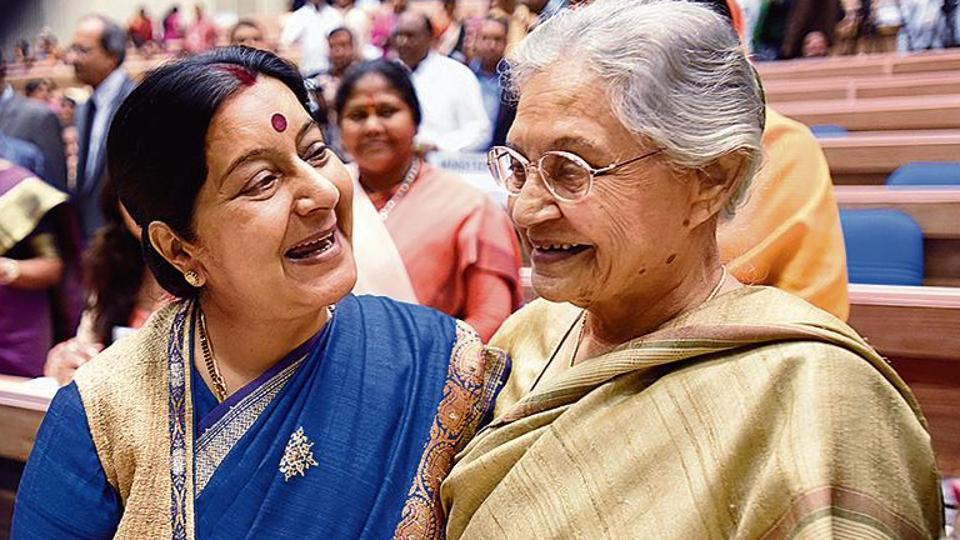
Sushma Swaraj’s politics was of grace and gumption. She died young but had belonged to the group of politicians whom I consider the connecting link between today’s crop and those who had emerged from the freedom struggle. Lal Krishna Advani was her mentor and Jayaprakash Narayan an abiding influence for reasons shared by a legion of socialist and right-wing activists who fought Indira Gandhi’s Emergency.
Swaraj battled the Congress tooth and nail in Parliament and on the streets. But her equation with its leaders was a study in conviviality. If, in 2004, she famously threatened to shave her head and launch a “Quit India Movement-2” to block Sonia Gandhi from becoming Prime Minister, six years later, in 2010, she joined the Gandhis at a prayer meeting on the death anniversary of Rajiv Gandhi at his Samadhi, Veer Bhumi.
She then was the Leader of Opposition in the Lok Sabha. Having had to park the car at some distance from the venue, Swaraj didn’t mind walking the remaining stretch. Never before had a Bharatiya Janata Party (BJP) leader of any consequence done such a thing. The Gandhi family reciprocated with Rahul calling on her at AIIMS where she had undergone a kidney transplant in 2016.
My own personal experience of her human side at the time was overwhelming. It had become a regimen with me to enquire about her health from her husband and my friend, Swaraj Kaushal. One night, I got a call from her residence with her on the line: “Vinodji, Swaraj told me that you always asked him about me. I thought I must tell you personally that I’m back home and doing fine. I will start meeting friends after a few days as doctors have advised me to guard against infection.”
Such niceties, natural to politicians of Swaraj’s stock, are rare these days. Prime Minister Narendra Modi found use for her knack of keeping channels open with political opponents when he had to reach out to Sonia Gandhi after the 2016 surgical strikes on terror launch pads in Pakistan.
Recovering from illness, Sonia Gandhi was unable to attend an all party meeting convened by the government to build a united Indian response on the cross-border strike. Swaraj visited her at 10, Janpath, enquired about her health and briefed her on the issue. By asking Sonia Gandhi whether she had any message for Modi, the external affairs minister let it known that she was there not in her personal capacity, but as an emissary of the PM.
Swaraj sowed and reaped a great deal of goodwill within the BJP. After their 2014 tussle on the leadership question, she repaired and enhanced her relations with Modi. Their equation was guided by mutual regard till she was his external affairs minister.
She did not protest when she faced a scathing attack from the media over the Lalit Modi episode, which couldn’t entirely have been of her making. Nor did she utter a word when the PM brought S Jaishankar in her place in the Foreign Office. Instead, she retired, despite being the same age as the 67-year-old Modi.
The message from her life is summed up aptly in the Hindi lines that translate to mean that in the end all humans are reduced to mere stories; what matters is the passion with which we’ve lived: “Kirdar shiddat se nibhaeye zindagi mein, kahani tou ek din sabhi ko bannaa hai…”











