
 E-Paper







Roshan Kishore is the Data and Political Economy Editor at Hindustan Times. He heads the newsroom's data journalism team, which produces Number Theory, a daily data-driven feature for the print edition and the HT app. Number Theory uses data analysis and story-telling based on it to add value to the newsroom’s daily coverage by putting stories in a larger context on a range of issues, including politics, macroeconomy, markets, global affairs and climate. Under his leadership HT’s data journalism work has established itself as a niche product in Indian journalism and pushed the boundaries of marrying academic rigour with news sense and speed. Along with writing and editing data stories, he has also been writing a weekly political economy column called Terms of Trade for HT Premium. A trained economist with an MPhil degree from Jawaharlal Nehru University, Kishore has also been a visiting fellow at the Centre for Advanced Studies of India (CASI) at the University of Pennsylvania. Along with his journalistic work, his writings have also appeared in journals such as the Economic and Political Weekly and working papers for CASI and UNESCAP.
Number Theory: Some sector-wise ideas for the Budget
What can the Budget do for major stakeholders in the Indian economy? Here are three ideas worth considering.


Every finance minister, while presenting the Budget, has the unenviable task of pleasing all stakeholders in the economy.

Such efforts must be balanced against the resource constraints facing the government and the congruence of proposals being made with the larger interest; both short-term and long-term, of the economy.
What can the Budget do for major stakeholders in the Indian economy?
Here are three ideas worth considering. They are classified under the three broad sectoral categories of agriculture, industry and services.
Agriculture: Focus on capex to protect sustainability
This is going to be an area where the government will begin with some regret. Faced with large scale protests, it repealed three farm laws which were enacted in 2020.
If the government believed that the liberalisation of agricultural markets – the farm laws sought to deregulate output markets, remove restrictions on movement and storage of food items and give greater freedom for contract farming – was absolutely essential for changing the fortunes of the farm sector in the country, it is going to have to make an alternative plan to take care of agriculture now. What can the government do in the farm sector?
With the Budget coming days before a critical state election cycle begins, temptation will be high to announce some politically rewarding sops for farmers.
An increase in payments under the PM-KISAN scheme could be one such idea. With payments fixed at ₹6,000 per year since 2019, the real value of payments has been eroded. But while this could be politically rewarding, it is unlikely to bring long-term gains to farming or farmers.
Here is another idea worth considering. Long-term data on composition of investment in agriculture shows that share of public spending has become very low. Data from the ministry of agriculture shows that public capital formation in agriculture was just 16% of total capital formation in the sector in 2019-20.

To be sure, the ratio of public versus private capital formation has been falling in both agricultural and non-agricultural sectors of the economy.
However, it is important to realise that India needs to reinvent the complementarities between public and private investment in agriculture now more than ever.
With environmentally damaging agricultural practices posing a threat to both agricultural sustainability and public health at large – stubble burning to save on high labour costs is one such example – the state needs to provide a nudge to farmers to move away from such practices.
Can the budget offer something to encourage public investment in agriculture which can address sustainability concerns? While a monetary allocation on this count would be an excellent idea, the centre could also offer a scheme incentivising state governments to take up this task.
Industry: Clarity on the role of FDI
From the ambitious Make in India project launched within months of assuming office in 2014 to the Production Linked Incentive (PLI) schemes announced in 2020, the Narendra Modi government continues to pursue the cause of giving a boost to manufacturing in India.
Foreign Direct Investment (FDI) has a crucial role to play in this sector. Of late, there has been a lot of debate about the role such programmes can play in giving a boost to domestic economy.
A section of economists, including former chief economic advisor Arvind Subramanian has been arguing that for manufacturing to get a boost India, the government needs to undo what Subramanian describes as an inward turn in trade policy which has entailed an increase in average tariff levels and staying out of major multilateral trade agreements such as the Regional Comprehensive Economic Partnership (RCEP).
“Higher tariffs will make it difficult for firms to access the inexpensive, high-quality imported inputs on which modern production depends” Subramanian and his co-author wrote in a recent essay published in Foreign Affairs.
Should the government heed to the counsel being offered by Subramanian and lower tariff levels and other non-tariff barriers to trade?
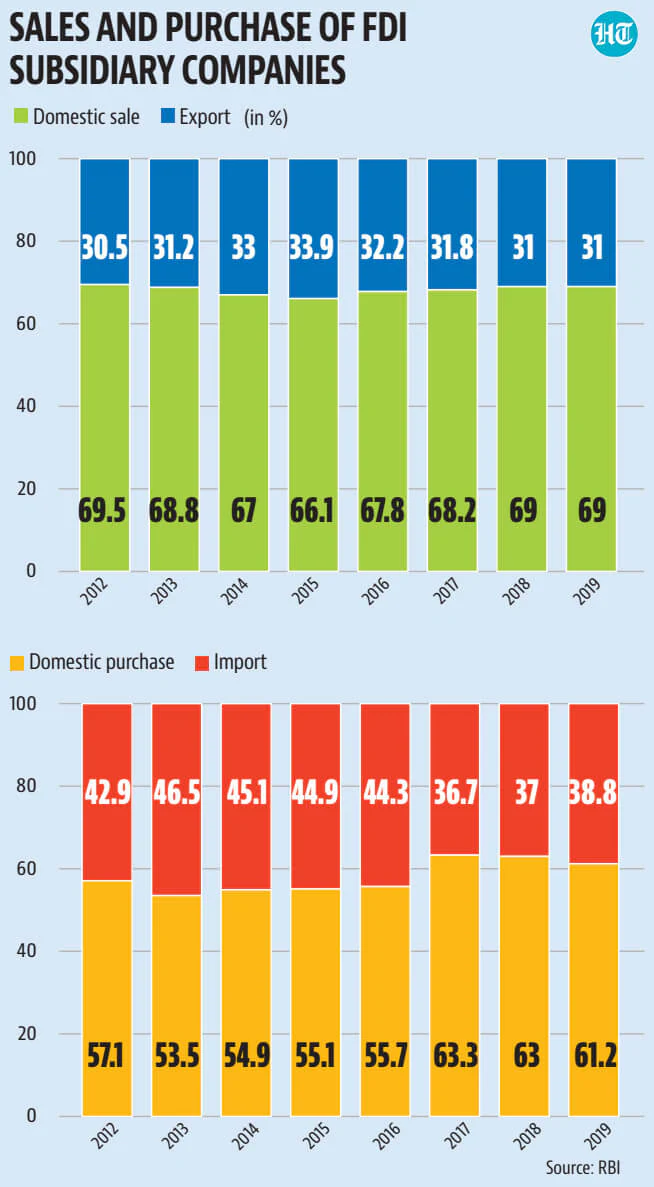
While the argument looks promising, it needs to be seen against the fact that FDI-recipients in the country are primarily dependent on domestic demand and also source a greater share of their inputs from the domestic market.
A trade liberalisation strategy which leads to fall in domestic consumption of FDI affiliates without an increase in their export earnings could actually generate headwinds for economic growth in the short-run. Economic policy, the Budget included, needs to maintain this fine balance.
Services: Celebrate the performers, but protect the employment intensive sectors which have suffered
India’s pandemic woes would have been much worse had the IT sector not had a major footprint in the economy.
As lockdown restrictions derailed economic activities and firms across the spectrum struggled to adapt to remote work, IT companies actually saw their fortunes rising.
Sectors such as IT have also escaped the logistical problems such as disruption of global value chains which continue to plague high technology manufacturing.
A September 2021 note by Pranjul Bhandari, chief India economist at HSBC put the share of services in India’s exports at 41% in 2021, the highest since 2000.
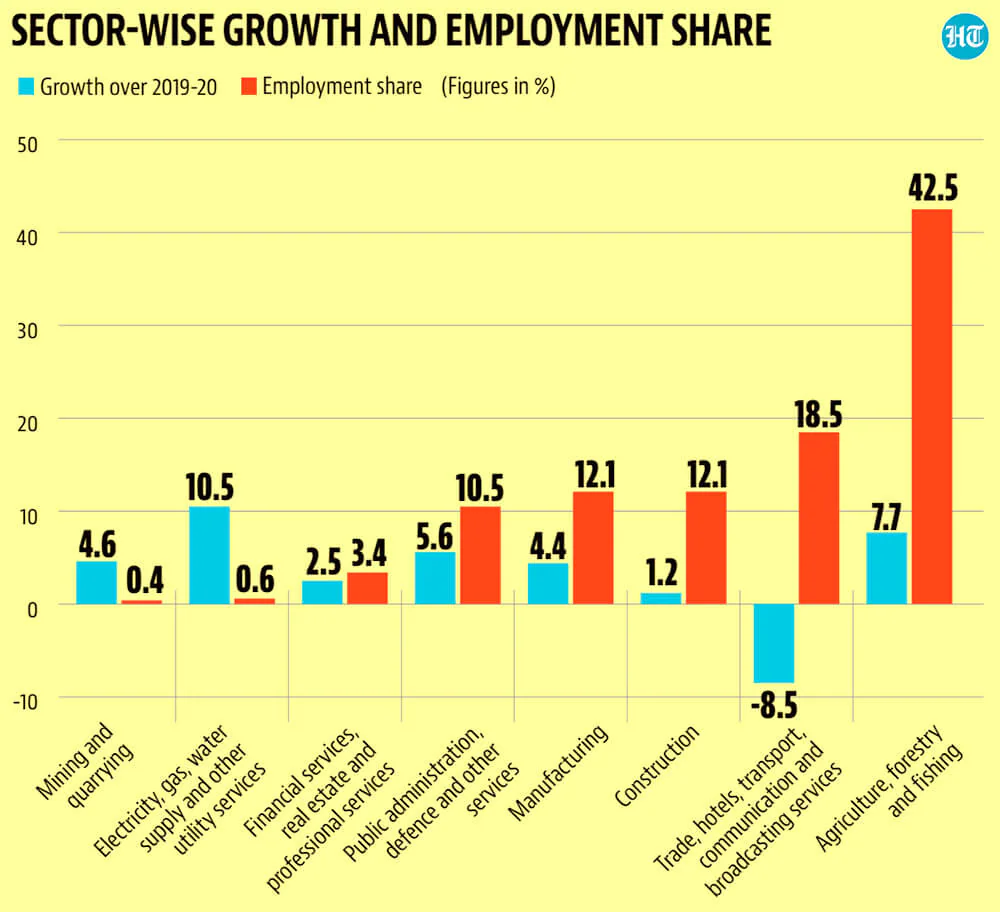
To be sure, the post-pandemic performance of India’s service sector is not an unambiguously happy story. While high-skill services have done well, contact-intensive service sectors which have a very large share in employment continue to suffer.
The trade, hotel, transport, communication and broadcasting services sub-sector of the service economy is the only major sub-sector which will continue to see a contraction in 2021-22 as per the first advanced estimates of Gross Value Added (GVA) released earlier this month.
It is important that the Budget keeps in mind this asymmetry in the service sector and takes substantive steps to offer relief to alleviate the pain in contact-intensive services.











