
 E-Paper







Shishir Gupta is Executive Editor at Hindustan Times and one of India's top journalists covering national security, strategic affairs, foreign policy and geopolitics. Over the past three decades, he has extensively reported on India's military, diplomatic and security landscape, covering every major conflict and national security challenge, from the 1999 Kargil War and the 2020 East Ladakh standoff to Operation Sindoor in 2025. He has also covered major terror attacks, including the IC-814 hijacking, the 26/11 Mumbai attacks and the 2025 Pahalgam terror strike, along with numerous Pakistan-backed terrorist incidents in the Kashmir Valley and across India. He has reported on national and state elections for more than three decades. A recognised authority on strategic affairs, Gupta has covered India's nuclear programme since the Pokhran-II (Shakti series) tests in May 1998 and has written extensively on global nuclear issues, Indian diplomacy and the country's expanding global outreach. He has also reported widely on international conflicts and terrorism, with a special focus on the Indian subcontinent. Gupta has interviewed Prime Minister Narendra Modi more than four times, including Modi's first interview with the print media after becoming Prime Minister in May 2014. His other interviews include three with the Dalai Lama, as well as conversations with Benjamin Netanyahu, Amit Shah, Yogi Adityanath, S. Jaishankar, Nirmala Sitharaman and Piyush Goyal. He is the author of Indian Mujahideen: The Enemy Within (Hachette, 2011) and Himalayan Face-off: Chinese Assertion and Indian Riposte (Hachette, 2014). He was awarded the Chevening-Wolfson Joint Scholarship at Wolfson College, University of Cambridge, UK, in 1998 and participated in the International Visitor Leadership Program (IVLP) of the US State Department in 2006. He received the Ben Gurion Prize from Israel in 2011 and the K. Subrahmanyam Prize for Strategic Studies in 2015 from the Manohar Parrikar Institute for Defence Studies and Analyses (MP-IDSA). Since 2024, he has hosted Point Blank, Hindustan Times' weekly YouTube show on global geopolitics.
Rafales practising night-flying in Himachal Pradesh
The Rafales, based in Ambala, are understood to be practising night flying in the mountainous terrain of Himachal Pradesh so that the Golden Arrows squadron, with its Meteor beyond-visual-range air-to-air missiles and SCALP air-to-ground standoff weapons will be ready if the situation deteriorates on the LAC.


The five newly acquired top-of-the-line Rafale fighter jets from France are being kept away from the 1,597-km long Line of Actual Control (LAC) in the Ladakh sector out of concern that People’s Liberation Army (PLA) radars in occupied Aksai Chin could identify their frequency signatures and jam the signals in a worst-case scenario.
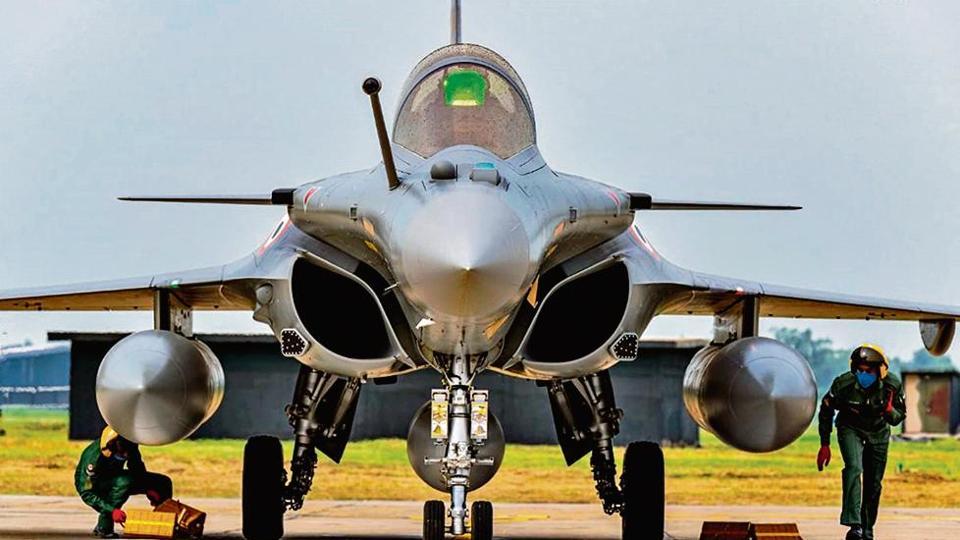
The Rafales, based in Ambala, are understood to be practising night flying in the mountainous terrain of Himachal Pradesh so that the Golden Arrows squadron, with its Meteor beyond-visual-range air-to-air missiles and SCALP air-to-ground standoff weapons will be ready if the situation deteriorates on the LAC.
According to South Block officials, the Rafale fighters are “fully operational,” with the first 18 platforms to be placed in Ambala and the next 18 fighters to be based in the Hashimara airbase near the border with Bhutan. Military aviation experts say the Rafales can also be used for training purposes in the Ladakh sector as all these fighters are equipped with programmable signal processors (PSP) or the capacity to change signal frequencies in the event of hostilities.
“Even though the Chinese PLA have placed their electronic intelligence radars on mountain tops in occupied Aksai Chin area for clear line of sight, the wartime signature of Rafale will be different from that in practice mode. The PLA aircraft detection radars are good as they have been manufactured, keeping the US air force in mind,” an expert said, requesting anonymity.
Although Indian and Chinese diplomatic and military interlocutors are engaged in a constant dialogue for total disengagement of troops in eastern Ladakh, the three services are not only focused on the western sector but also the remaining part of the LAC as well as on the high seas. Last week, Army Chief General M.M. Naravane made it clear to central and eastern army commanders that they should not be caught by surprise by the PLA on the LAC and should be in the highest state of military preparedness.
The Indian Navy has also been directed to monitor the Arabian Sea, Bay of Bengal and the Indian Ocean to ensure that Chinese PLA warships are kept at bay from the Indian sea board and island territories. The surface and undersea assets are on operational alert with Chinese ships being monitored from the Malacca Straits to the Gulf of Aden.
Although the Chinese PLA’s air activity has reduced in the Ladakh sector as compared to the first week of July after the Galwan Valley flare-up in June, the Indian Air Force is taking no chances and is watching the Lhasa Gonggar and Hotan airbases in particular. On June 15, a violent brawl flared between Indian and Chinese solders in Galwan in eastern Ladakh, leaving 20 Indian soldiers dead and an unspecified number of Chinese casualties.











