
 E-Paper




IAF, Central Sanskrit University sign MoU to provide yoga training to Agniveervayu
The agreement specifically identifies providing Agniveervayu with formal qualifications “enhancing their post-release career prospects and social value”

 Prefer HTon Google


The Indian Air Force (IAF) has partnered with the Central Sanskrit University (CSU), New Delhi, to provide Agniveervayu personnel with an accredited qualification in yoga instruction, aimed at enhancing their career prospects after release from military service, while improving their physical fitness, mental resilience and stress management skills.
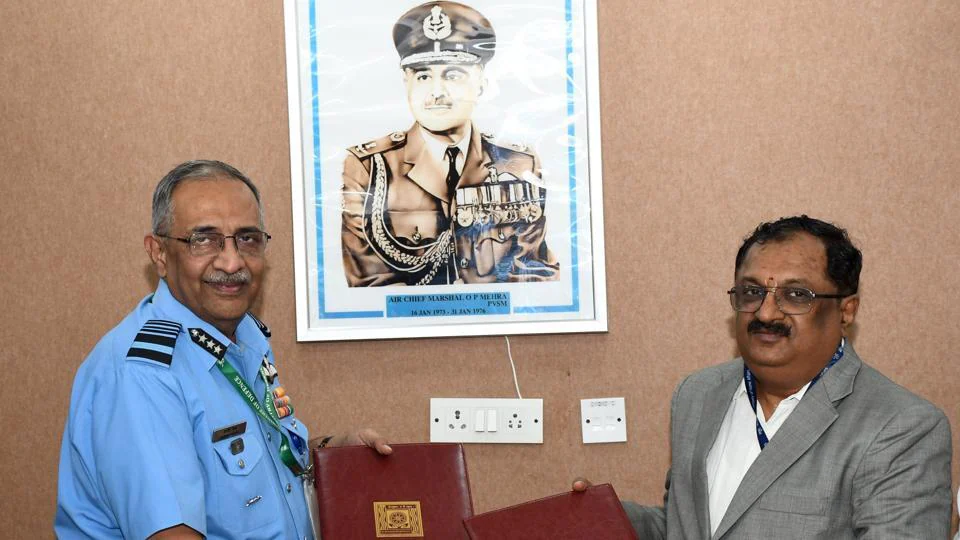
The agreement, signed on Thursday at Air Headquarters in the national Capital, specifically identifies providing Agniveervayu with formal qualifications “enhancing their post-release career prospects and social value” as one of its objectives. Under the MoU, the university will conduct an eight-week, 100-hour online course leading to a Yoga Instructor (Level-I) certification.
The collaboration, under the university’s ‘Yoga Setu’ programme will train Agniveervayu personnel, young recruits serving in the IAF under the Centre’s Agnipath scheme, as entry-level instructors in basic yoga practices under CSU’s ‘Yoga Setu’ programme, or ‘bridge of yoga’, which is aimed at taking India’s traditional yoga knowledge to the armed forces. The training is tentatively scheduled to begin tentatively on February 11, 2027, a CSU official told HT.
Also Read:CAPFs debated merit, ex-Agniveer postings before Union Cabinet’s Agnipath overhaul approval
Changes to the Agnipath Framework
The collaboration comes amid changes in the Centre’s Agnipath recruitment framework, with the government extending the engagement of Agniveers who are not initially selected for regular service and providing them another opportunity to join the permanent cadre. The revised arrangement, however, retains the possibility of personnel leaving service after four or six years, depending on their choices and selection outcomes.
Under the original Agnipath scheme, introduced in June 2022, recruits were engaged for four years, with only 25% eligible for retention in regular service for another 15 years. The remaining 75% were to leave the armed forces after completing their tenure.
However, on November 4, the Union Cabinet approved an additional two-year engagement for the remaining 75%, following which willing Agniveers would be offered regular enrolment, subject to objective selection criteria. The revised framework also provides higher remuneration, an enhanced Seva Nidhi package and seniority benefits during the extended engagement.
The move came weeks before the three services, IAF, Army and Navy, were set to release more than 18,300 Agniveers from the first batch and retain only the 25% selected on merit for another 15 years under the Agnipath scheme’s earlier provisions.
HT on November 10 reported the revised framework would apply to around 300,000 Agniveers currently serving in the three services. Those completing the additional two years would have an opportunity to become permanent, subject to eligibility criteria and individual consent.
Against this backdrop, the IAF-CSU MoU seeks to provide “formal accredited qualifications” that could also have value when personnel eventually transition out of military service. To be sure, in July 2026, the government told Lok Sabha that there would be 50% reservation for ex-Agniveers in constable (general duty) and rifleman recruitment in the Central Armed Police Forces (CAPF) and Assam Rifles, along with age relaxation and exemptions from certain recruitment tests.
Course Structure and Objectives
100-hour course over eight weeks
According to the MoU details seen by HT, the programme will comprise 50 hours of theory and 50 hours of practical training. The theoretical component will cover stress management, yoga philosophy and yogic diet, while practical sessions will include yoga postures (asanas), meditation and pranayama.
The programme will be conducted through secure online platforms approved by the IAF. Practical yoga classes will also be held at respective units under the supervision of trained Armed Forces personnel. The MoU says the online format is necessary because Agniveers are posted across multiple locations and their large numbers make it difficult to attend in-person training without affecting operational commitments.
The MoU lists six objectives, to “promote physical fitness and mental well-being” of Agniveervayu personnel; “enhance stress management, mindfulness, and resilience”; encourage “healthy lifestyle practices through regular Yoga”; and provide accessible online yoga sessions without affecting their operational commitments. It also seeks to foster collaboration in “health, wellness, and preventive care”, besides providing Agniveers with “formal accredited qualifications enhancing their professional career prospects and social value”.
Also Read:New Agnipath framework applicable only to current Agniveers
Institutional Partnership and Capacity Building
CSU vice-chancellor Prof Shrinivasa Varakhedi described the partnership as a meaningful coming together of two national institutions.
“You are in the sky, and we are at the roots; yoga makes this connection even stronger,” he said at the signing ceremony.
He added that the initiative aimed not merely to award certificates but also to turn personnel into “ambassadors of yoga”, taking its message to their workplaces, families and society.
The defence ministry in a press statement on Thursday said IAD and CSU signed MoU “to facilitate access to structured learning and certification opportunities in Yoga for Agniveervayu.”
“This collaboration marks another significant step in the IAF’s continued endeavours towards capacity building, skill enhancement and facilitating wider educational opportunities for Agniveervayu through collaborations with higher education institutions,” the ministry said.
Frequently Asked Questions











