...
...
Next Story

Has demonetisation worsened India’s ‘change’ problem?

The statistics worth looking at in this year’s report are those which give details about the denomination-wise break-up of the currency in circulation.

Updated on: Aug 31, 2018, 14:47:59 IST
Hindustan Times, New Delhi | By
Prefer HTon Google
Advertisement

The Reserve Bank of India released its annual report for 2017-18 on August 29, 2018. That 99.3% of the demonetised currency has come back to the banking system has been the most talked about part of the report, but this is not exactly new information. It was already known that most demonetised currency had come back to the banking system.
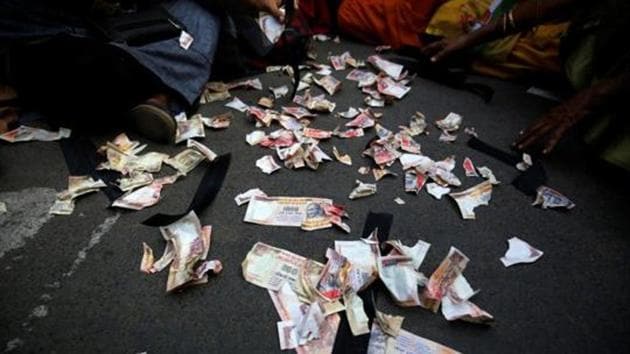
Pieces of old fake 1000 rupee notes lay on the street during a protest, organised by  Congress party, to mark a year since demonetisation was implemented by Prime Minister Narendra Modi, in Ahmedabad, India. (REUTERS File Photo)
Pieces of old fake 1000 rupee notes lay on the street during a protest, organised by Congress party, to mark a year since demonetisation was implemented by Prime Minister Narendra Modi, in Ahmedabad, India. (REUTERS File Photo)

The statistics worth looking at in this year’s report are those which give details about the denomination-wise break-up of the currency in circulation. These figures are better than last year’s figures because now the remonetisation process can be assumed to have been fully completed. Not much seems to have changed in terms of value.

Slightly more than one-third of the total currency in circulation was in denominations greater than Rs 500 at the end of March 2018, which is nearly the same as the corresponding values in March 2015 and 2016, the last two years before demonetisation. However, things have changed drastically in terms of volume. The share of currency in denominations greater than Rs 500 has more than halved in March 2018, compared to what it was in March 2016

In a perfect world, this should not matter. The supply of currency both in value and volume terms has increased compared to what it was before demonetisation. But this could have changed things in a big way in the conduct of day-to-day transactions. Here’s why.

A person conducting a retail cash transaction above Rs 500 in the pre-demonetisation period would have needed a lesser amount in change than she would in the post-demonetisation world. The reason being, she will now have to get a Rs 2000 note changed and not a Rs 1000 note which was the case earlier. Ceteris paribus this is bound to lead to an increase in transaction demand for notes with denominations up to Rs 500. Given the fact that the share of currency notes of denominations up to Rs 500 has not changed before and after demonetisation, there is a probability of increased cash crunch in day to day cash transactions.

Should the RBI have altered the distribution of currency in circulation after demonetisation in favour of lower denomination notes? The 2017-18 Annual Report’s statistics on indent (reacquisition) and supply of different denominations of currency notes supports this argument. Indeed, through 2017, and 2018, several news reports have said RBI is stepping up printing of smaller denomination currency notes. The shortfall in supply compared to indent of ₹100 notes was more than 60% in 2017-18.

. Now that we know that demonetisation has not led to any drastic increase in cashless payments, this factor deserves greater attention.

 
ABOUT THE AUTHOR
HT News Desk

Follow the latest breaking news, major developments and agenda-setting stories from India and around the world with the newsdesk at Hindustan Times. Operating round the clock, the desk brings together experienced editors, reporters and correspondents to deliver fast, accurate and contextual reporting across subjects that influence public policy, governance, business, society and international affairs. The HT News Desk covers politics, elections, government policies, the economy, business and markets, science and technology, the environment, law and order, infrastructure, education, climate issues and geopolitics, while closely tracking developments across states, institutions and global capitals. The team also leads coverage of major breaking news events, policy announcements, court proceedings, natural disasters, public emergencies and significant international developments. Reports published by the newsdesk are based on information gathered from reporters on the ground, official statements, government agencies, court records, regulatory filings, recognised institutions and other authoritative sources. Stories undergo editorial scrutiny and verification processes to ensure accuracy, fairness and relevance, and are updated as events evolve and additional information becomes available. Whether covering a key political decision in New Delhi, an economic policy shift affecting millions, a landmark court ruling or a major global event, the HT News Desk aims to provide readers with reliable, fact-based journalism that delivers not only the latest developments but also the context and analysis needed to understand their wider implications.

Get Latest News, breaking headlines, and top India News, and today real-time updates from across the nation. Stay informed on politics, government policies, crime, Today Weather, and major developments on Hindustan Times
SHARE THIS ARTICLE ON
Notifications

Get breaking alerts directly from the newsroom

Notifications are on!You'll be notified when news breaks