
Two figures from Tamil Nadu's history, Veerapandiya Kattabomman and Ettappan, have moved to the centre of the delimitation debate after an exchange between Congress MP Rahul Gandhi and ally Dravida Munnetra Kazhagam (DMK) chief M K Stalin.
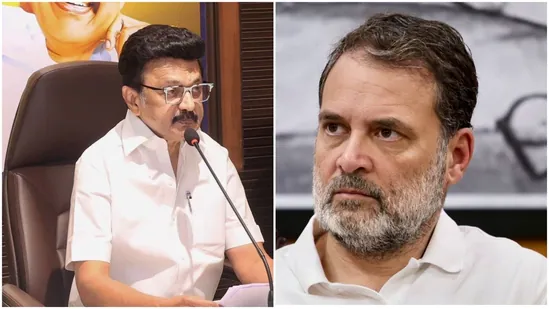
A day after the DMK announced support to the delimitation bill, Stalin on Sunday said every party decision has always been made “keeping the interests of Tamil Nadu and our Tamil people as the foremost consideration”.
He said his party will “not compromise on this path” and exuded confidence that “history will judge us as Kattabommans and not Ettappans”.
Deep Dive
Why did MK Stalin refer to Kattabomman and Ettappan in the delimitation debate?
Who were Kattabomman and Ettappan, and what do their names represent?
What did Rahul Gandhi mean by calling a supporter of delimitation a ‘21st-century Ettappan’?
The former Tamil Nadu chief minister made the remarks in response to Congress MP Rahul Gandhi’s appeal to the DMK to join forces with the Indian National Developmental Inclusive Alliance (INDIA) bloc in defeating the Constitution amendment bill.
“Brother Stalin has always stood like a rock against anti-Tamil forces. In the national interest, in Tamil Nadu’s interest and to protect the Constitution, we have to defeat this bill together,” Gandhi, who is scheduled to meet Stalin on Sunday, wrote on X.
On August 3, the Leader of Opposition in Lok Sabha had made a similar appeal against the bill and said “anyone who supports delimitation is betraying Tamil Nadu, betraying the future of Tamil Nadu, and allowing the RSS and BJP to attack the people of Tamil Nadu and its future.” “Such a person is a 21st-century Ettappan,” he added.
Who was Veerapandiya Kattabomman?
{{/usCountry}}On August 3, the Leader of Opposition in Lok Sabha had made a similar appeal against the bill and said “anyone who supports delimitation is betraying Tamil Nadu, betraying the future of Tamil Nadu, and allowing the RSS and BJP to attack the people of Tamil Nadu and its future.” “Such a person is a 21st-century Ettappan,” he added.
Who was Veerapandiya Kattabomman?
{{/usCountry}}While Veerapandiya Kattabomman was an 18th-century chieftain of Panchalankurichi in present-day Tamil Nadu, who fought against the British East India Company, Ettappan in colloquial Tamil is a derogatory term for a betrayer or traitor.
Kattabomman was born on January 3, 1760. He was the polygar (chieftain) of Panchalankurichi, a role the British refused to recognise. Kattabomman saw this as an attempt by the British to take over his domain, and he fought back. According to Google Arts & Culture, he was captured and hanged at Kayathar on October 16, 1799, at the age of 39.
Who was Ettappan Nayak?
Ettappan, on the other hand, refers to Ettappan Nayak, the ruler of Ettayapuram who is widely remembered in Tamil popular history as a symbol of treachery for allegedly betraying Kattabomman to the British. According to Wikipedia, Ettappan was a close confidante of Kattabomman. Ettappan, however, passed information on Kattabomman's whereabouts to the British, following which the latter was arrested and hanged to death.
Kattabomman in cinema
A Tamil film on Kattabomman titled ‘Veerapandiya Kattabomman’ on Kattabomman was produced and directed by BR Panthulu in 1959. According to Wikipedia, the film was adapted from a play that went by the same title, by veteran author Sakthi T. K. Krishnasamy.
DMK’s change in stance
The DMK has 22 Lok Sabha and eight Rajya Sabha MPs. The DMK had opposed the earlier delimitation proposal tooth and nail, with Stalin, chief minister then, burning a copy of the bill in April while clad in black.
On Saturday, Stalin said the DMK has decided to support the delimitation bill as it incorporates the party's twin key demands and said it was a victory for the party's struggle and a win for all southern states.
Firm no to reduction in 7.18% share of seats in the Lok Sabha and demand for maintaining the existing proportion of Parliamentary representation among states based on 1971 Census were the two demands.
