
About 30 years after iron scaffoldings came up around the 13th century Sun Temple at Konark, a world heritage site, archaeological officials have removed them making it easy for visitors to view the exquisite artwork on its wall without the obstruction of the iron poles.
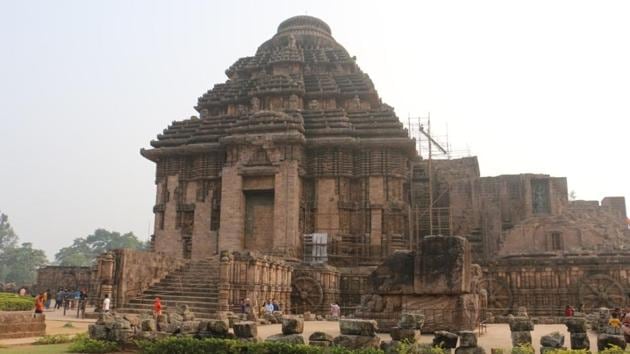
The scaffoldings were removed following recommendation of a three-member team of Roorkee’s Central Building Research Institute (CBRI) that is studying its structure for last several decades, said officials of Archaeological Survey of India which is in charge of upkeep and maintenance of the temple.
The operation to remove the scaffoldings began last December.
“We have removed the scaffoldings in almost in 99 per cent part of the temple as CBRI is done with its study of the temple. The rest would be removed within a week. We are working as per the guidelines of the High Court,” said Arun Mallik, superintendent of Archaeological Survey of India, Bhubaneswar.
Iron scaffoldings came up around the temple in 1992 so that CBRI experts could climb up and study the structure. The entire structure was covered with scaffoldings by 2011. CBRI has so far submitted two volumes of report to the ASI after its study.
Badal Das, president of Konark Suraksha Samiti, a local outfit raising its voices for better preservation of the temple, said the removal of the scaffoldings would bring in more tourists to the monument. “Tourists can now see the Sun temple clearly,” said Das.
{{/usCountry}}Badal Das, president of Konark Suraksha Samiti, a local outfit raising its voices for better preservation of the temple, said the removal of the scaffoldings would bring in more tourists to the monument. “Tourists can now see the Sun temple clearly,” said Das.
{{/usCountry}}The 800-year-old monument built by Ganga dynasty king Langula Narasingha Dev about 800 years ago to worship the Sun God has already lost its main temple and Natya Mandap and only the Jagamohan (porch) remains. About 1,200 stone craftsmen and artists constructed the temple over a period of 16 years.
The removal of the scaffoldings came months after the CBRI suggested refilling the 130 ft-high structure with more sand to ensure stability of the Jagamohan as the same filled more than a century ago has sunk by 12 feet. In 2015, CBRI had carried out a 3-D laser scan of the monument using a Ground Penetrating Radar that showed the danger the monument faced from the nature.
Between 1900 and 1903, the British government had undertaken a major preservation work of the Sun temple and sealed its interiors with sand to prevent the structure from collapsing. The four entrances to the structure were sealed off and its inside filled with sand so as to prevent the structure from collapsing. However, those huge quantity of sand have caused cracks on the structure from inside.
ASI officials said that the body will soon be taking important steps for conservation of the Sun temple. “A decision on refilling of sand will be taken soon,” said the ASI official.
ABOUT THE AUTHOR
Follow the latest breaking news, major developments and agenda-setting stories from India and around the world with the newsdesk at Hindustan Times. Operating round the clock, the desk brings together experienced editors, reporters and correspondents to deliver fast, accurate and contextual reporting across subjects that influence public policy, governance, business, society and international affairs. The HT News Desk covers politics, elections, government policies, the economy, business and markets, science and technology, the environment, law and order, infrastructure, education, climate issues and geopolitics, while closely tracking developments across states, institutions and global capitals. The team also leads coverage of major breaking news events, policy announcements, court proceedings, natural disasters, public emergencies and significant international developments. Reports published by the newsdesk are based on information gathered from reporters on the ground, official statements, government agencies, court records, regulatory filings, recognised institutions and other authoritative sources. Stories undergo editorial scrutiny and verification processes to ensure accuracy, fairness and relevance, and are updated as events evolve and additional information becomes available. Whether covering a key political decision in New Delhi, an economic policy shift affecting millions, a landmark court ruling or a major global event, the HT News Desk aims to provide readers with reliable, fact-based journalism that delivers not only the latest developments but also the context and analysis needed to understand their wider implications.
