
With the government preparing to return to Parliament next week with a Constitution amendment that requires a two-thirds majority, the fate of 20 Trinamool Congress (TMC) MPs facing disqualification proceedings before Lok Sabha Speaker Om Birla could have a bearing on the legislative arithmetic. Their continued membership of the House, and consequently their right to vote, has assumed significance as the government prepares to make another attempt to push through its proposed delimitation exercise and women’s reservation legislation.
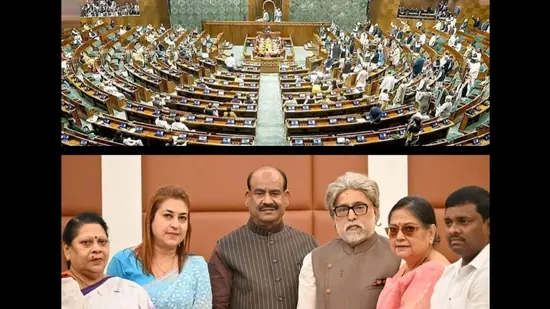
The 20 MPs broke away from the TMC in June and announced their merger with the little-known Nationalist Citizens Party of India (NCPI), which supports the ruling National Democratic Alliance (NDA). TMC’s Lok Sabha leader Abhishek Banerjee subsequently approached the Speaker seeking their disqualification under the anti-defection law. Nearly six months later, the proceedings remain inconclusive, although all 20 lawmakers submitted individual replies on November 24, defending their decision to leave the party.
TMC MP Sagarika Ghose has now questioned the delay, alleging that the Speaker has not decided the petitions despite the Supreme Court’s directions for an expeditious resolution. She has also raised a pertinent question: will these MPs be allowed to vote on the delimitation Bill when their disqualification petitions are pending, and would their votes remain valid if they are subsequently disqualified?
The constitutional position, as settled by the Supreme Court, is that the mere pendency of a disqualification petition does not suspend an MP’s membership or voting rights. Unless the Speaker passes an order disqualifying them before the vote, the 20 lawmakers remain entitled to participate in parliamentary proceedings. Even a subsequent disqualification would not automatically invalidate votes cast while the proceedings were pending.
{{/usCountry}}The constitutional position, as settled by the Supreme Court, is that the mere pendency of a disqualification petition does not suspend an MP’s membership or voting rights. Unless the Speaker passes an order disqualifying them before the vote, the 20 lawmakers remain entitled to participate in parliamentary proceedings. Even a subsequent disqualification would not automatically invalidate votes cast while the proceedings were pending.
{{/usCountry}}Featured Video
Speaker’s authority and the merger question
The Tenth Schedule of the Constitution vests the authority to decide disqualification petitions in the Speaker or Chairman of the House concerned. Under paragraph 6, the Speaker’s decision is final, subject to judicial review by constitutional courts. The Election Commission of India (ECI) has no role in deciding whether the MPs have incurred disqualification under the anti-defection law. Its jurisdiction over disputes involving a party's name and election symbol is a separate exercise.
The central question before Birla is whether the rebels can claim protection under paragraph 4 of the Tenth Schedule, which exempts legislators from disqualification when their original political party merges with another political party, provided at least two-thirds of the members of its legislature party agree to the merger.
Although 20 of the TMC’s 28 Lok Sabha MPs comfortably meet the numerical requirement, that alone does not establish a valid merger. In its May 2023 judgment in Subhash Desai Vs Principal Secretary, Governor of Maharashtra, a five-judge Constitution bench of the Supreme Court clarified that the merger contemplated under the Tenth Schedule must involve the original political party and cannot be established merely by two-thirds of its legislators breaking away. The distinction between the original political party and its legislature party is therefore central to the Speaker’s adjudication.
The Speaker must examine whether the original TMC merged with the NCPI or whether the 20 legislators merely formed a separate group and sought to align themselves with another political formation. The rebels maintain that their action is constitutionally protected, while the TMC argues that the anti-defection law does not permit a merger confined to the legislature party.
Why the MPs retain their voting rights
The Subhash Desai judgment also provides a clear answer on the immediate question of voting rights. The Supreme Court held that legislators facing disqualification petitions retain the right to participate in House proceedings while their cases remain undecided. It further clarified that the validity of proceedings conducted during this intervening period cannot be made dependent on the eventual outcome of the disqualification proceedings.
The court also held that disqualification operates prospectively and does not relate back to the date on which the member allegedly incurred it. Consequently, if the Speaker disqualifies the 20 MPs after the proposed constitutional amendment is put to vote, their participation in that vote would not become invalid retrospectively.
This makes the timing of the Speaker’s decision particularly important. Unless an order is passed before the House votes, the 20 MPs can exercise their parliamentary rights, irrespective of the merits of the disqualification petitions.
Supreme Court’s warning against delay
The Speaker's authority, however, does not translate into an unrestricted discretion to keep disqualification proceedings pending indefinitely.
In Kihoto Hollohan Vs Zachillhu (1992), the Supreme Court upheld the Speaker’s role as the adjudicating authority under the Tenth Schedule, while making clear that the decision is amenable to judicial review. The court held that the Speaker functions as a tribunal while deciding such petitions.
More significantly, in Keisham Meghachandra Singh Vs Speaker, Manipur Legislative Assembly (2020), the Supreme Court held that disqualification petitions should ordinarily be decided within three months, barring exceptional circumstances. The ruling was intended to prevent delays from defeating the very purpose of the anti-defection law by allowing legislators facing disqualification to continue enjoying the benefits of membership.
The Supreme Court, which last heard Banerjee’s plea seeking a time-bound decision in September, reiterated that the matter required expeditious adjudication. While declining to impose a specific deadline, the bench led by Chief Justice of India Surya Kant invoked the three-month principle laid down in Keisham Meghachandra Singh and emphasised the need for an early resolution.
The submission of replies by all 20 MPs on November 24 removes one procedural hurdle, but it does not resolve the substantive dispute. The Speaker must now examine their defence and decide whether the merger claim satisfies the constitutional requirements.
The numbers behind the dispute
The stakes are heightened by the government’s earlier defeat on April 17, when its Constitution amendment secured 298 votes against the 352 required for a two-thirds majority among the 528 members present and voting.
The revised legislation seeks to increase the Lok Sabha’s strength from 550 to 850 seats, facilitating 33% reservation for women in Parliament and state assemblies before the 2029 general election. With the NDA currently having around 320 members, the government needs support from outside its alliance and favourable attendance to secure passage.
The status of the 20 TMC MPs could therefore influence the arithmetic. If they remain members, they retain their right to vote. If disqualified before the vote, the House’s effective membership and the applicable two-thirds threshold would change, but the government’s own voting strength would also fall.
With a crucial constitutional amendment awaiting Parliament’s consideration, Birla’s handling of the petitions could prove consequential not only for the future of the 20 MPs but also for the numbers game surrounding one of the government’s most significant legislative initiatives.
ABOUT THE AUTHOR
Utkarsh Anand is the National Legal Editor at Hindustan Times, where he leads the newspaper's coverage of the Supreme Court, constitutional law, the judiciary and the Union law ministry. He joined Hindustan Times in 2020 after stints at Press Trust of India (PTI), The Indian Express and CNN-News18, and has over two decades of experience reporting on law, governance and public policy. His work has focussed on some of India's most consequential constitutional and legal developments, including the Supreme Court's judgments on Article 370, marriage equality, decriminalisation of homosexuality, the Babri Masjid dispute, electoral reforms and judicial appointments. He specialises in making complex legal proceedings and judgments accessible to readers while examining their wider social and political impact. Beyond daily reportage, Utkarsh has led investigative projects and enterprise reporting that have shaped public debate and prompted institutional responses. His work has received several journalism awards, including the Ramnath Goenka Excellence in Journalism Award. As National Legal Editor, he has also played a key role in expanding Hindustan Times' legal journalism footprint, mentoring reporters and strengthening coverage across platforms. A Chevening South Asia Journalism Programme Fellow, Utkarsh regularly writes analyses on the judiciary and constitutional issues, and his reporting is widely followed by lawyers, judges, policymakers, academics and readers seeking clarity on India's evolving legal landscape.
