
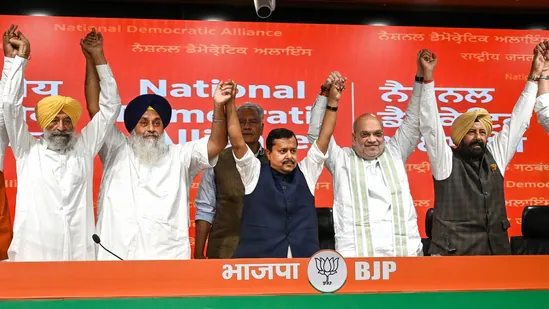
On Tuesday, the Bharatiya Janata Party (BJP) and the Shiromani Akali Dal (SAD) announced their alliance for the forthcoming Punjab elections. These two parties have come together in an alliance after six years. In September 2020, the SAD walked out of the National Democratic Alliance (NDA) government against the now-withdrawn three farm laws, which were introduced via the ordinance route during the pandemic. Losing one of its oldest allies in the SAD was the biggest cost the BJP paid for pushing the farm laws.
The BJP eventually took back the farm laws after almost a year-long protest by farmers; primarily from Punjab, who were supported by their comrades from the other two green revolution areas: Haryana and western Uttar Pradesh. It remains to be seen how much of a pushback the SAD-BJP alliance faces from the Punjab peasantry, which used to be the core support base of the SAD in its good old days. One can expect a conciliatory tone from the BJP on the question of farm laws during the campaign.
Something else happened more recently to facilitate the coming together of the BJP and the SAD. The Union Cabinet, earlier this month, made significant changes to the Agnipath scheme for the armed forces. This scheme – it originally sought to retire 75% of the Agniveers (soldiers, not officers) recruited after four years – will now offer everyone an opportunity to stay back, marking a de facto status quo ante as far as recruitment in the armed forces was concerned. The primary motivation behind the scheme; even though it was never explicitly mentioned, was to ease the fiscal strain of salaries and pensions on the defence budget. Many well-meaning observers had underlined its possible pitfalls when it was introduced. Good sense has prevailed in the government, thankfully.
Punjab has been a historical recruiting ground for the armed forces, and even though recruitment numbers might have fallen in the more recent past, working conditions for armed forces personnel continue to evoke a strong political pitch in the state, especially in its villages. If the first cohort of Agniveers had retired and been in their villages when the Punjab elections were being held – which they would have been minus the change to the scheme – the BJP and its allies would have had to face headwinds. To be sure, the political considerations behind rolling back the scheme transcend Punjab.
{{/usCountry}}Punjab has been a historical recruiting ground for the armed forces, and even though recruitment numbers might have fallen in the more recent past, working conditions for armed forces personnel continue to evoke a strong political pitch in the state, especially in its villages. If the first cohort of Agniveers had retired and been in their villages when the Punjab elections were being held – which they would have been minus the change to the scheme – the BJP and its allies would have had to face headwinds. To be sure, the political considerations behind rolling back the scheme transcend Punjab.
{{/usCountry}}The virtual rollback of the Agnipath scheme, along with the proposal of a revised Unified Pension Scheme—which promises guaranteed returns while maintaining employee contributions (the pre-reform Old Pension Scheme did not require employee contributions but promised guaranteed returns and the New Pension Scheme introduced in 2004 did not offer guaranteed returns but required employee contribution) — and the One-Rank One-Pension Scheme for the armed forces (which the BJP promised in its 2014 campaign and delivered on), constitute what fiscal hawks would call a retrograde movement on current and more importantly, future government spending on salaries and pensions.
The proposed farm laws, in this author’s view, wasted, perhaps irreversibly, critical political capital which is desperately needed to save Punjab’s agriculture from its farmers. An entrenched policy framework that procures crops unsuited to Punjab's agrarian ecology — which has become toxic (the pun is intended given what is happening to Punjab’s water and soil quality) — is making Punjab’s agriculture unsustainable in the long run. Indian agriculture’s problem (essentially a stall in yields and a worsening viability crisis) is broader-based than Punjab's is. Punjab, however, remains its most pressing crisis.
The BJP’s about-turn on these critical issues due to fears of political damage, underlines an often-ignored reality about so-called reforms in India. They are unlikely to be pushed or sustained when the aggrieved party is numerically significant, and, more importantly, organised. Rollback of farm laws, rollout of pension schemes etc. are some such examples. No such roadblock to reform exists when gains from these accrue to capital – such as the reduction in corporation tax rates, which none other than the Prime Minister has now said did not lead to expected gains for the economy – or they tend to take away benefits from a large majority which is not organised well enough to mount a political resistance. The dilution of the welfare statutes in the Mahatma Gandhi National Rural Employment Guarantee Scheme (MGNREGS) during its rechristening and redesigning as the Viksit Bharat – Guarantee for Rozgar and Ajeevika Mission (Gramin) (VB-G RAM G) is a good example of the latter.
What does it really mean for India’s long-term economic and strategic prospects?
To put it provocatively, India's policymakers over the decades have been looking for the so-called (reform) keys (to unlock growth) like the proverbial drunk. They have been looking under the lamp-post, i.e., sectors where it is easier to do reforms even if likely gains are much lower, than in the dark where the political opposition is larger but the gains could also be big. That the current government, despite being in a politically comfortable situation, has often followed this script, confirms the nature of the problem.
Should this be our destiny? In a world of alibis, perhaps yes. But the question really worth asking is different. Why is it that India has not been able to reduce the opposition to reforms in politically difficult areas?
Is it a result of successive governments' bona fides being in doubt in the eyes of the majority, which thinks that its interests are not being served under the existing economic order even as the rich become richer? Is it because the reforms so far have failed to generate broad-based upward mobility and made people extremely apprehensive about letting go of existing benefits? Or is it a breakdown in political dialogue with the masses that has led to our top-down reforms not unleashing the energies of creative destruction for the economy at large? Is it, perhaps, this deficit in dialogue that political parties seek to bridge by offering palliatives?
These are difficult to answer questions. But answer them, we must. Because if we don't, political pragmatism will continue to preserve a status quo that rewards the politically organised and the economically well-off at the cost of widespread well-being and national empowerment. The parting and reunion of the BJP and the SAD in Punjab is a perfect example of what might have been.
(Roshan Kishore, HT’s Data and Political Economy Editor, writes a weekly column on the state of the country’s economy and its political fall out, and vice-versa)
ABOUT THE AUTHOR
Roshan Kishore is the Data and Political Economy Editor at Hindustan Times. He heads the newsroom's data journalism team, which produces Number Theory, a daily data-driven feature for the print edition and the HT app. Number Theory uses data analysis and story-telling based on it to add value to the newsroom’s daily coverage by putting stories in a larger context on a range of issues, including politics, macroeconomy, markets, global affairs and climate. Under his leadership HT’s data journalism work has established itself as a niche product in Indian journalism and pushed the boundaries of marrying academic rigour with news sense and speed. Along with writing and editing data stories, he has also been writing a weekly political economy column called Terms of Trade for HT Premium. A trained economist with an MPhil degree from Jawaharlal Nehru University, Kishore has also been a visiting fellow at the Centre for Advanced Studies of India (CASI) at the University of Pennsylvania. Along with his journalistic work, his writings have also appeared in journals such as the Economic and Political Weekly and working papers for CASI and UNESCAP.
