
 E-Paper






Paras Singh is a New Delhi-based journalist with Hindustan Times, where he serves as Deputy Metro Editor. He reports on urban governance, the Delhi government, the Delhi BJP, water management, the environment, communities and city life. He joined Hindustan Times in 2021 after beginning his journalism career at The Times of India in 2016, where he covered civic bodies, the water and power sectors, and urban infrastructure. Over the last decade, some of his reporting has led to significant public impact, with investigations into environmental violations, corruption and illegal industrial activity contributing to multiple judicial interventions by the National Green Tribunal and the Delhi High Court. A graduate of St. Stephen's College, University of Delhi, Paras studied journalism from the Indian Institute of Mass Communication (IIMC), New Delhi. Having extensively covered the capital's evolving civic and governance landscape, his recent work increasingly explores Delhi's history, built heritage, urban evolution and the relationship between people and place, alongside continuing to report on governance and public policy.
E-rickshaws: Illegal charging and cheap batteries safety hazards
Delhi’s deadly e-rickshaw fires highlight risks from overcrowded, often illegal charging hubs; nearly half of the city’s 400,000 e-rickshaws are unregistered.


While the precise cause of the deadly fire at a residential building in east Delhi’s Vishwas Nagar is yet to be established, investigators suspect it may have been triggered either by an overloaded electrical network, with several e-rickshaws being charged simultaneously, or by a substandard battery, officials aware of the probe said.
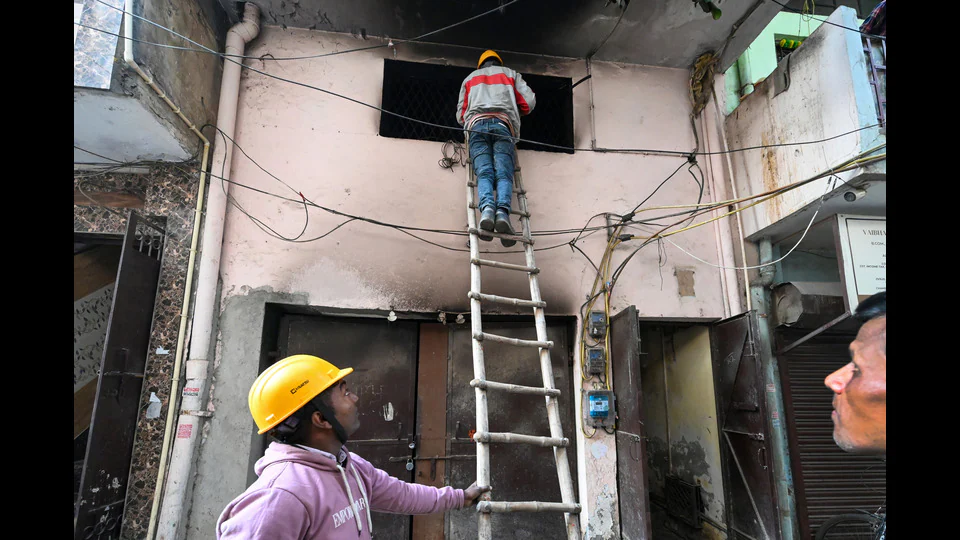
The officials said the incident was not an isolated case, pointing to a series of fires involving poorly maintained, overloaded and, in some instances, illegal e-rickshaw charging points across the Capital. The risks are particularly acute given that an estimated 400,000 e-rickshaws operate in Delhi, nearly half of them without registration, they said.
The Sunday morning fire, which killed four men, originated in the ground-floor parking area of a residential building where a large number of e-rickshaws were being charged in a cramped space.
On August 17 this year, a similar fire at an e-rickshaw charging area in west Delhi’s Raghubir Nagar killed two people. Fatal fires have also been reported over the past 18 months in Dilshad Colony, Ram Nagar in Shahdara and Ghonda, among other areas.
With the mushrooming of e-rickshaws in the city, an informal charging network has also expanded. These makeshift facilities, which often operate illegally and offer charging at cheaper rates, frequently lack basic safety measures, making them vulnerable to short circuits and fires. Despite the risks, they remain widely used by drivers seeking affordable charging options.
A government official, speaking on condition of anonymity, estimated that illegal charging could be causing annual power theft losses of ₹100-120 crore in Delhi.
“Approximately 200 e-rickshaw charging locations, with a load of about 2-3 MW, are booked for electricity theft every year in Delhi. In Delhi, it’s estimated that around 50% of e-rickshaws are involved in power theft, resulting in a loss of 15-20 MW across the city, translating to an annual loss of around ₹100-120 crore,” the official said.
Delhi recorded another fire linked to e-rickshaw parking and charging on Sunday. At least six people, including two children, were rescued after a fire broke out inside a residential building with an e-rickshaw parking area in northwest Delhi. Police said nobody was injured, but more than 15 e-rickshaws were gutted.
Officials said such makeshift charging points operate in basements, parking areas and warehouses, while some operators allegedly draw electricity directly from power transmission lines.
“Exposed electricity wires left open during illegal charging and non-adherence to safety standards often cause sparks and short circuits. These exposed live wires also pose a danger to the public, especially children playing in these areas during the daytime. Such open wires have led to electrocutions in the past. Ordinary electrical sockets lack the protection required to handle power surges. Proper charging stations are necessary to prevent accidents,” a second official said.
Large-scale illegal charging at a single, unplanned location can also put pressure on the existing electricity network, potentially causing breakdowns and voltage fluctuations that affect other consumers in the area, power department officials said. “The solution to avoid such fatalities is to take legal connections and use good-quality batteries,” another official said.
Areas where officials have identified high levels of e-rickshaw-related power theft include Mukherjee Nagar, Rohini, Bawana and Narela in north Delhi; Sangam Vihar, Jamia, Batla House, Kalkaji, Tughlakabad, Sarai Kale Khan, Dakshinpuri and Govind Puri in south Delhi; and Raghubir Nagar, Tagore Garden, East Sagarpur, Madipur, Nangloi, Paschim Vihar, Matiyala and Mahavir Enclave in west Delhi.
Officials said many e-rickshaws involved in power theft were charged in batches through organised networks. Drivers and owners typically paid charging and parking operators a fixed fee of ₹200-400 per vehicle per day.
“Charging usually takes 6-7 hours and occurs at night. Sometimes they hook power from nearby main power lines and transformers, posing additional safety risks,” an official said.
According to official estimates, around 400,000 e-rickshaws are operating in Delhi, but only 205,665 are officially registered, leaving nearly 200,000 unregistered vehicles plying on city roads.
The Delhi government has proposed capping the number of e-rickshaws in the Capital at 250,000, restricting individual ownership to five vehicles and requiring every vehicle to obtain a digital compliance certificate. These provisions are part of a draft policy issued for public consultation in October.
ABOUT THE AUTHOR

Stay updated with all top Cities including, Bengaluru, Delhi, Mumbai and more across India. Stay informed on the latest happenings in World News along with Delhi Election 2025 and Delhi Election Result 2025 Live, New Delhi Election Result Live, Kalkaji Election Result Live at Hindustan Times.











