
 E-Paper




Delhi top cop defends denotification of Jantar Mantar as protest site
The affidavit said 78 foreign embassies and diplomatic missions, along with 99 central government offices, are located within four kilometres of Jantar Mantar.

 Prefer HTon Google


Delhi Police commissioner Anurag Kumar on Tuesday defended the denotification of Jantar Mantar as a designated protest site, telling the Supreme Court that the decision was based on a Union home ministry committee’s unanimous recommendation and a changed security and public-order situation. He stressed that the right to protest cannot translate into a right to demonstrate at a particular location.
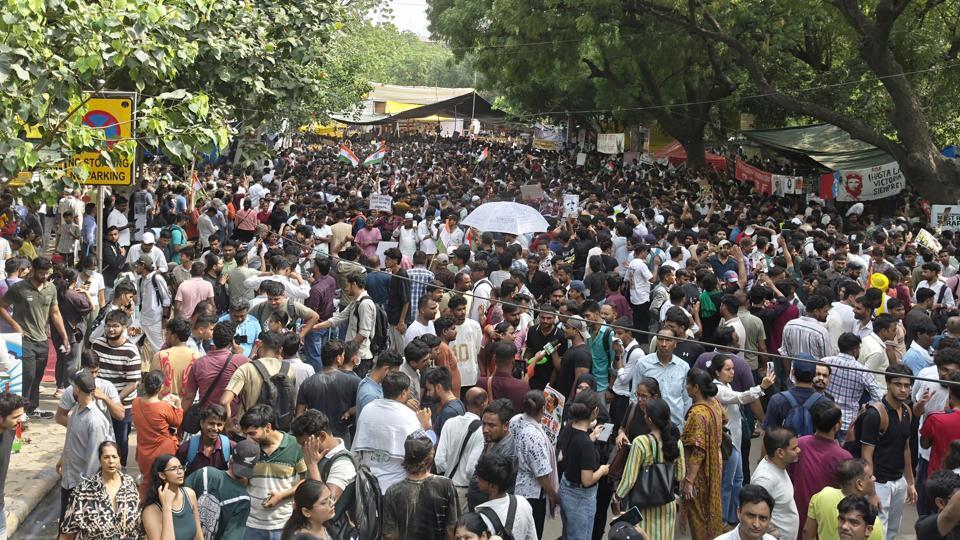
In a counter-affidavit, filed in response to a petition by advocate Swaty Singh, the police chief said that the right to protest at a particular site was not an absolute right, especially when doing so could affect the rights of non-protesting citizens to earn their livelihood, undertake business and other activities peacefully, and move freely in the national capital.
“The petitioners cannot claim any vested right to insist upon a particular site for the purpose of exercising their right to protest,” Kumar said, urging the court not to interfere with what he described as an administrative and executive decision taken in the larger public interest.
Also read: No individual, group can occupy a designated protest site indefinitely: Supreme Court
Security and public-order concerns
The affidavit, filed before a bench led by Chief Justice of India (CJI) Surya Kant, provides a detailed account of the factors behind the decision. The affidavit said 78 foreign embassies, diplomatic missions and offices of international organisations were located within a radius of around three to four kilometres from Jantar Mantar. The same area also housed 99 central government offices, ministries and autonomous institutions, including the Reserve Bank of India, which together received an estimated daily footfall of 146,000 people. It further cited around 7,017 private residential housing units, accommodating 36,685 residents, and 5,349 government residential units, housing another 27,881 people, in the vicinity.
Traffic congestion and disruption caused by protests, Kumar said, affected residents, commercial establishments and people visiting government offices.
The commissioner also flagged the proximity of Ram Manohar Lohia Hospital, saying demonstrations and traffic disruption obstructed the movement of patients and ambulances requiring urgent medical attention. He said there was heightened need to regulate activities in the area due to the proximity of the new Parliament premises.
It also sets the venue’s maximum capacity at approximately 1,500 people, with over 1,300 protests and demonstrations held there annually.
Also read: Delhi Police protest: SOP, courtroom security among 5 demands raised by protesting cops
Committee recommends alternative protest venues
Kumar said the decision followed a memorandum dated August 26—from a committee constituted by the MHA—to examine whether Jantar Mantar Road should continue as a designated protest site and recommending alternative locations. The report was sent by the ministry to the Delhi Police on September 14, well before the Supreme Court’s October 9 observations on the need to identify alternative venues for demonstrations.
It identified Ramlila Maidan in central Delhi, CBD Ground in east Delhi and Burari Ground in north-west Delhi as suitable alternatives, the affidavit said.
Kumar said the ground situation had changed substantially since the Supreme Court’s July 2018 judgment in the Mazdoor Kisan Shakti Sangathan case, which had recognised the right to dissent and peaceful protest while directing the police to frame guidelines to regulate demonstrations at Jantar Mantar. The court had also clarified that the right to protest at a particular place was not, by itself, a fundamental right and that authorities could shift demonstrations to another location, he pointed out.
Kumar said that the continued use of Jantar Mantar as a protest venue constrained access to emergency services, such as ambulances and fire brigades, and created public-order and safety concerns in the neighbourhood.
Citing police records, the affidavit stated that between August 1 and August 27, the stretch around Jantar Mantar accounted for approximately 250 distress calls, 109 FIRs of theft, 10 FIRs of motor vehicle theft, more than 254 property-loss claims, 23 FIRs of public-order violations, rioting and defacement, and 14 cases under provisions of the Delhi Police Act pertaining to public nuisance.
July 20 protest cited
The commissioner said the number of protesters who gathered on July 20 far exceeded the venue’s assessed capacity, creating a risk of stampede as crowds spilt towards Janpath and Connaught Place. Such gatherings, Kumar said, could disrupt daily life, affect livelihoods and restrict citizens’ movement to important government offices.
The affidavit also argued that the geographical proximity of a protest venue to the seat of government was no longer relevant in an era of digital technology and widespread social media use. The three alternative locations, it said, offered a more practical framework for peaceful assembly.
Also read: INDIA bloc marches together from Delhi's Ramlila Maidan in display of force against CEC
Supreme Court to examine challenge
The filing comes after the Supreme Court, on October 15, issued notice on Singh’s challenge to the denotification and said it would examine whether the decision was based on an independent assessment of Jantar Mantar’s suitability or followed primarily from its October 9 observations. The Centre and Delhi Police had then maintained that the decision flowed from the MHA committee’s recommendations, which predated the court’s observations.
The October 9 observations came in the wake of the July protests by the Cockroach Janta Party, seeking the resignation of then education minister Dharmendra Pradhan that entailed a proposed march towards Parliament that was followed by violence and a police crackdown. The court had called for suitable alternative sites where peaceful and lawful demonstrations could be held without compromising public safety or essential services.
Delhi Police issued a circular on October 11, denotifying Jantar Mantar with immediate effect and identifying Ramlila Maidan, CBD Ground and Burari Ground as alternative venues.
The immediate context was Delhi Police’s refusal to permit a proposed October 10 demonstration at Jantar Mantar, alongside extensive security measures that included restrictions affecting metro services and railway movements.
Also read: INDIA bloc marches together from Delhi's Ramlila Maidan in display of force against CEC
Petition questions access to alternative venues
Singh’s petition contends that the alternatives may not provide citizens with a meaningful, accessible and affordable avenue to exercise their right to protest, and that shifting demonstrations away from the centre of the Capital could diminish their public impact. Ramlila Ground, which spans around 12 acres and hosts several events throughout the year, may not be readily available for protests, the plea argued, adding that the other two venues were located on the city’s outskirts.
Frequently Asked Questions


Stay updated with all top Cities including, Bengaluru, Delhi, Mumbai and more across India. Stay informed on the latest happenings in World News along with Delhi Election 2025 and Delhi Election Result 2025 Live, New Delhi Election Result Live, Kalkaji Election Result Live at Hindustan Times.











