
With the conclusion of the paddy harvest in Punjab, farm fire cases have climbed to 7,006 this season, marking a nearly 40% jump from the previous year’s 5,114 incidents. The sharp uptick breaks a six-year downward trend and has rattled state authorities and enforcement agencies.
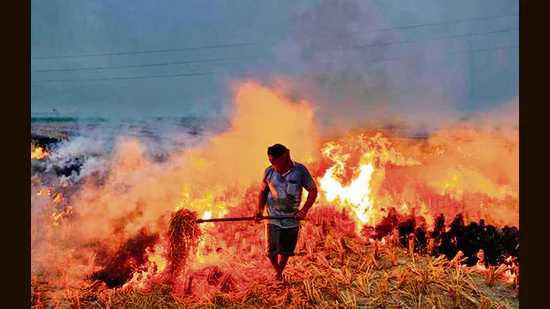
Farm fires have surged despite the government spending ₹576 crore on subsidised machinery for in-situ and ex-situ paddy straw management. Out of 24,817 subsidised machines supplied to farmers, 17,200 were super seeders and 1,100 were balers.
This rise in incidents persists even with strict enforcement, which includes 11,000 monitoring groups and 1,200 round-the-clock parali (straw) protection teams led by deputy commissioners and sub-divisional magistrates.
In 2024, 10,909 cases of farm fires were recorded in kharif (paddy) harvest and before that in 2023, 36,650 cases were reported. While the Commission for Air Quality Management (CAQM) has directed the state government to eliminate stubble burning entirely, this year’s spike makes that zero-incident target look increasingly difficult to achieve.
Half of the cases (3,492) were reported in five hotspot districts: Ferozpur at the top with 906 cases, followed by Sangrur (793), Tarn Taran (711), Bathinda (638) and Patiala (444).
Ludhiana-based state remote sensing centre started monitoring fire cases from September 15 and monitoring will continue until November 30. The centre fetches data from NASA satellites. For the past few days, fire cases have been steady, and according to officials in the state agriculture department, the harvest has completely finished.
{{/usCountry}}Ludhiana-based state remote sensing centre started monitoring fire cases from September 15 and monitoring will continue until November 30. The centre fetches data from NASA satellites. For the past few days, fire cases have been steady, and according to officials in the state agriculture department, the harvest has completely finished.
{{/usCountry}}“Although the harvest season has practically ended, satellites continue to record scattered fire incidents,” said agriculture department additional director Jagdish Singh. He said while it is unclear if all of these are actual farm fires, they are still added to the department’s official tally.
“Field reports indicate that the fires are occurring mostly in patches after baling and have reduced in overall intensity,” he said.
According to him, the lesson for the upcoming season is “waste to wealth,” and it is better if farmers understand this sooner rather than later. “One trolley laden with 150 quintals of paddy straw sells for ₹60,000 and the price will increase in the future,” he said.
A Punjab Pollution Control Board official, who serves as the state-level nodal officer for paddy straw management, expressed concern over the recent uptick in fire counts, especially after steady reductions over the past few years.
“We see an increase in the number because of two spells of rainfall during the harvest, which delayed harvesting, and in the panic to prepare for upcoming rabi crops, farmers in some pockets resorted to burning of straw,” he said.
₹1.2cr penalties imposed on defaulting farmers
The Punjab Pollution Control Board (PPCB) has imposed environmental cess penalties totaling ₹1.23 crore on defaulting farmers, of which ₹43.35 lakh has been recovered. Additionally, 2,144 FIRs were registered under Section 223 of the BNS, and 2,268 red entries were recorded in the farmers’ revenue records, which could result in an embargo on their crop loans. Furthermore, at least 41 nodal officers were prosecuted under CAQM provisions, and 2,193 show-cause notices were issued.
ABOUT THE AUTHOR
Gurpreet Singh Nibber is an Assistant Editor with the Punjab bureau. He covers politics, agriculture, power sector, environment, Sikh religious affairs and the Punjabi diaspora. His work in agriculture sector has been recoganised by Indian Council of Agricultural Research (ICAR), New Delhi with an award of excellence. He possesses a strong understanding of politics, people and cultural ethos of the land, and believes in fact based ethical journalism. In his career spanning over two decades he continues to write path breaking people centric, investigative and policy driven stories with an indelible impact.
