
 E-Paper







Hitender Rao is Senior Associate Editor covering the state of Haryana. Over the past three decades, he has reported on politics, governance, economy, migration, public policy and legal affairs. His work focuses on investigative and data driven journalism with a particular focus on government accountability, public institutions, corporate regulations and judiciary. A Fulbright- Humphrey scholar, he has covered elections, legislative developments, public finances, infrastructure, law enforcement and policy formulation, widely reporting on issues that shape governance and public life across the state through in depth reporting and analysis. He has also written extensively on migration issues and public administration focusing on how government decisions, institutions and corporate sector influence citizens and public policy.
Virus shifting path towards northern Haryana
Change of course: Trend is likely to stabilise in about 2 weeks,says ACS, health


Gradually changing paths, the coronavirus seems to be shifting its spread from the national capital region (NCR) abutting New Delhi to the northern districts of Haryana.
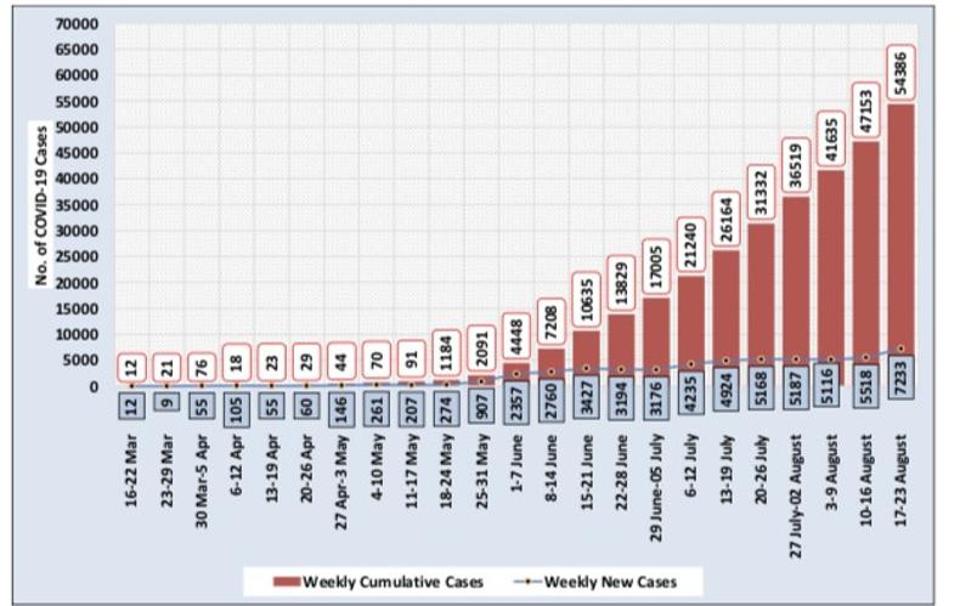
Data for the last week showed that the number of new infections reported from districts bordering the national capital seems to be stabilising, but the virus is spreading fast in the northern districts.
On August 23, five northern districts had reported 36% of the new cases as compared to 31% from the five NCR districts. Similarly on August 24, 34% new infections were reported from five northern districts as against 31% from five NCR districts.
Seven northern districts had contributed 51% of the new infections reported on August 22 while four NCR districts threw up 24% fresh cases.
Additional chief secretary (ACS), health, Rajeev Arora, said the NCR districts have stabilised now and are reporting much lesser number of cases (about 20-30%). “The spurt in northern districts is understandable keeping in view the free movement of men and material. However, our assessment is that this spike trend will also stabilise in about two weeks,” he added.
As per the health department statistics, 7,233 new infections were reported last week (August 17-23) as compared to 5,518 cases logged between August 10 and August 16.
Number of critical value districts on a rise
With the virus moving northward, the number of districts attaining critical values as per the Union health ministry parameters have started increasing. Eighteen districts, most of which are from northern part of the state, have now more than 15 active cases per lakh population, a critical value. These are Ambala, Bhiwani, Charkhi Dadri, Faridabad, Fatehabad, Gurugram, Hisar, Kaithal, Karnal, Kurukshetra, Mahendergarh, Panchkula, Panipat, Rewari, Rohtak, Sirsa, Sonepat and Yamunanagar.
Similarly, 15 districts, mostly from north, now have more than 200 active cases, another critical value parameter. These are Ambala, Faridabad, Gurugram, Hisar, Kaithal, Karnal, Kurukshetra, Mahendergarh, Panchkula, Panipat, Rewari, Rohtak, Sirsa, Sonepat and Yamunanagar.
Ambala, Faridabad, Gurugram, Mahendergarh, Panipat and Rewari have a sample positivity rate (confirmation rate) of above 6%, a critical value. Only Jind has a sample positivity rate of less than 2%, a desirable value.
The state, however, seems to be doing well on the case fatality rate parameters with 10 districts — Ambala, Bhiwani, Charkhi Dadri, Fatehabad, Hisar, Kaithal, Mahendergarh, Palwal, Panchkula and Rewari — having less than 1% fatality rate, a desirable value.
The doubling rate calculated over a seven-day period is more than 28 days in 12 districts, a desirable value as per the health ministry. Only Yamunanagar district with a doubling rate of less than 14 days has got tagged with the critical value.











