
 E-Paper





Jake Grewal: “It is affirming to discover that nature is far from binary”
The London-based artist on his debut solo art show in India at the Jhaveri Contemporary art gallery in Mumbai last month, the energy exchange between human figures and the landscape in his work, and on hate crimes against gay people




Why did you choose to title the show, ‘The Distance We Inherit’? Does it have to do with the fact that you have spent very little time in India though your father is Indian?
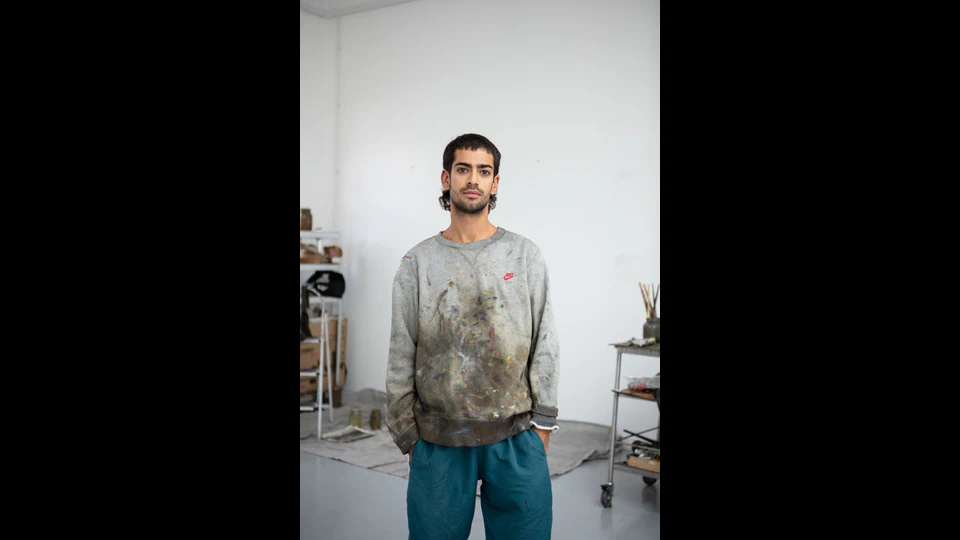
At the beginning of every show, I come up with a series of possible titles. I settled on this one because it felt kind of open. It hints at a generational detachment because I had never been to India until two years ago.
When I began to work on my debut solo show in India, this title felt right because it captures the push and pull of my struggle with identity. My father is Indian, and my mother is Welsh. But I didn’t feel as deeply connected to my Indian heritage as I do now. This shift happened during my research trip to India in 2024 while I was working on an exhibition called ‘Under the Same Sky’, which opened in 2025. The trip was supported by Studio Voltaire, an arts organization in London. I visited Goa, Amritsar, Kerala, Delhi, Mumbai, Varanasi, and Himachal Pradesh.
It was not an easy trip but it was fulfilling in many ways. Punjab is where my dad comes from, so we went to the Golden Temple in Amritsar. That was important to my paternal grandmother. This time, I have come to India with my dad, sister and mum for ‘The Distance We Inherit’. The title came up organically, and has a personal meaning to it.
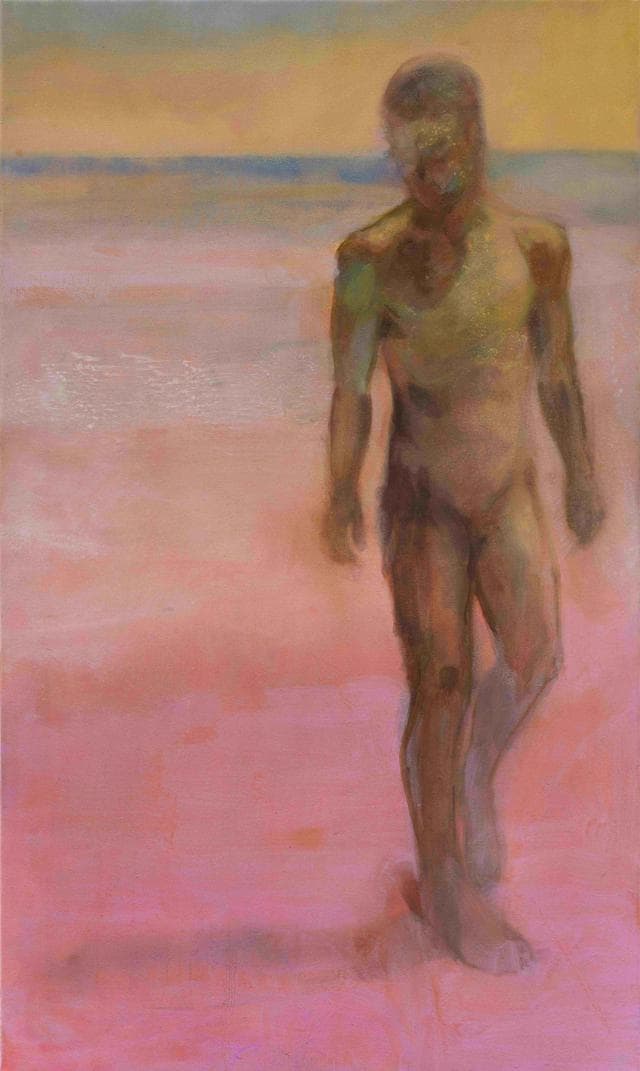
Your paintings make me think of the distance that has crept into the relationship between human beings and our natural environment. Since all the human figures in your paintings are located outdoors, does the title also signal a desire to bridge this distance?
You have hit on a significant part of my practice. I have never wanted the landscape to act as a stage. What is precious to me is the energy exchange between these human figures and the landscape. While travelling across India, it is exciting for an outsider like myself to notice the connection that people have with nature. You see banyan trees right in the middle of cities. You see cows, dogs, and monkeys everywhere. You see people praying to a river or the sun. Nature has always been a source of solace for me. But my connection with it grew deeper in the countryside, especially when I went to visit my maternal grandmother, and not in London. The process of working on ‘The Distance We Inherit’ helped me interrogate these feelings.
The dominant mode of engaging with nature is extractive. Forests, rivers and animals are treated as resources for human consumption. What you call ‘energy exchange’ sounds like a different way of relating. Why does reciprocity feel important to you?
This way of relating comes from my artistic inheritance. One of my favourite German Romantics — someone I have long admired — is Caspar David Friedrich. British Romantics like JMW Turner and John Constable have also been important influences. In their work, the landscape becomes a vehicle to talk about themes of religion and spirituality. This sense of being drawn to something larger than yourself — the vast cosmos — is ever present in their work.
The male nudes in your art appear in settings where they are surrounded by trees or water bodies. This is striking because queerness is often vilified by religion and criminalized by law as unnatural. Was this playing on your mind as a queer artist?
Being gay is legal in England today but the history of British art shows us that depictions of male nudity were often a subtle form of queer coding for figurative painters. They had to do this because being gay was vilified in the past. Painting naked figures is brave in an environment that shackles self-expression. As my own practice as a queer artist developed, I also began to learn more about queerness in nature. It is affirming to discover that nature is far from normative or binary. There are gay and genderfluid animals, besides animals who do not even need a mate to reproduce. Some animals have male as well as female reproductive organs. Some change their biological sex as they grow older. Nature is amazing. It has plenty of room for diversity. There is nothing unnatural about being queer because nature itself is queer.
Some of the human figures in your paintings seem to be gliding rather than walking. There is something ethereal about them, almost as if they are spectral presences. Is this an attempt to blur the boundaries between humans and their environment?
My work is internal and psychological. It is hard to explain this in a way that does not sound new age or hippy dippy. I do a lot of yoga. Whenever I need to reset or rebalance, or need courage and strength, I go out in nature. I draw and journal in nature. That makes me feel whole. In the cycle of day and night, and the transition from one season to another, there is a rhythm at work. My mum is a Kundalini Yoga teacher. All these influences find their way into my art.
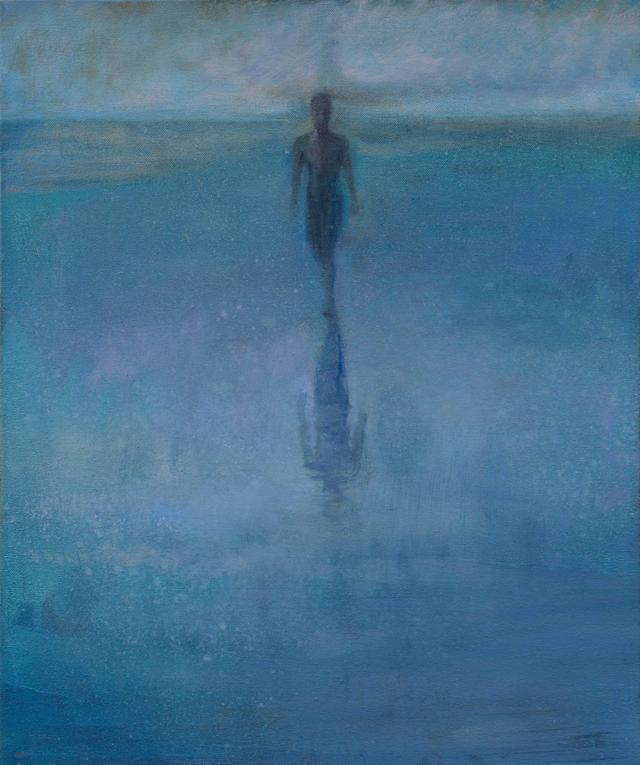
Tell us about your choice of materials.
The tradition of oil painting in England is a legacy that I draw upon. The materiality of oil paint is so versatile that you can manipulate and layer it according to your needs. I use marble dust to thicken the paint. In the past, I used a lot of watercolours and gouache and acrylic paint. The charcoal drawings that I make also inform the visual language of my figurative paintings.
Did you work with models, or draw these figures out of your imagination?
Many of these figures are modelled on myself. Observing and painting myself became a way of exploring what rage and shame and loneliness feel like in a human body. This approach is very much a part of my practice: looking at all the things you or other people want to push away.
A week before your show opened, a queer make-up artist called Mad Sandhu was shot dead in Amritsar in what was allegedly a hate crime. In 2025, the Amritsar Pride Parade was cancelled as the organizers received threats. What do you make of this cultural and political context?
I don’t think that anyone should be killed for being queer or talking about being queer. I am not a practising Sikh, and neither is my dad. My dad has always presented Sikhism as a faith that is accepting and inclusive. My parents went to fashion school, and they are not very religious. I went to church while growing up, because my mother is Christian, but not that often.Observing Punjabi culture in London, it was clear to me that queerness is not accepted easily. It does not fit into the normative version of masculinity that is seen as desirable. But I am grateful that I have received a lot of warm and encouraging feedback in India.
Chintan Girish Modi is a journalist, educator, literary and art critic, who also writes fiction, essays and poetry. He has contributed to various anthologies, including 101 Indian Children’s Books We Love (2013), Borderlines: Volume 1 (2015), Clear Hold Build (2019), Fearless Love (2019), and Bent Book (2020). He can be found @chintanwriting on Instagram and X.











